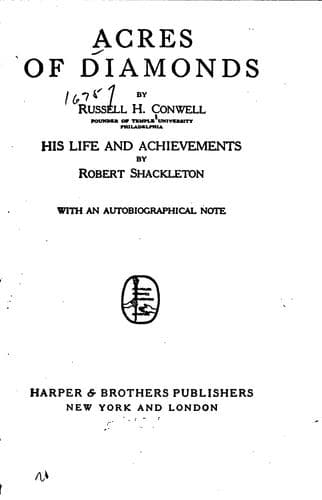
This stirring manifesto shows how to discover everything you need to succeed— where you least expect it.So begins one of the most famous speeches of the twentieth century, a talk that educator and minister Russell H. Conwell delivered before literally thousands of audiences before his death in 1925. In its printed version Acres of Diamonds reached millions of readers around the world. Conwell's great manifesto imparts one extraordinary lesson: All the wealth you could ever dream of, search for, or yearn after—in whatever form you wish for—exists right beneath your own feet. It is a message of determination, unconventional thinking, and positive living that came to influence a generation of motivational literature.The Success Classics edition of Acres of Diamonds also features two rare bonus works: Praying for Money and The Story of "Acres of Diamonds" by journalist Robert Shackleton.
Now John Jacob Astor illustrated what can be done anywhere. He had a
mortgage once on a millinery-store, and they could not sell bonnets
enough to pay the interest on his money. So he foreclosed that mortgage,
took possession of the store, and went into partnership with the very
same people, in the same store, with the same capital. He did not give
them a dollar of capital. They had to sell goods to get any money. Then
he left them alone in the store just as they had been before, and he
went out and sat down on a bench in the park in the shade. What was
John Jacob Astor doing out there, and in partnership with people who had
failed on his own hands? He had the most important and, to my mind, the
most pleasant part of that partnership on his hands. For as John Jacob
Astor sat on that bench he was watching the ladies as they went by; and
where is the man who would not get rich at that business? As he sat on
the bench if a lady passed him with her shoulders back and head up, and
looked straight to the front, as if she did not care if all the world
did gaze on her, then he studied her bonnet, and by the time it was out
of sight he knew the shape of the frame, the color of the trimmings, and
the crinklings in the feather. I sometimes try to describe a bonnet, but
not always. I would not try to describe a modern bonnet. Where is the
man that could describe one? This aggregation of all sorts of driftwood
stuck on the back of the head, or the side of the neck, like a rooster
with only one tail feather left. But in John Jacob Astor’s day there
was some art about the millinery business, and he went to the
millinery-store and said to them: “Now put into the show-window just
such a bonnet as I describe to you, because I have already seen a lady
who likes such a bonnet. Don’t make up any more until I come back.”
Then he went out and sat down again, and another lady passed him of
a different form, of different complexion, with a different shape and
color of bonnet. “Now,” said he, “put such a bonnet as that in the show
window.” He did not fill his show-window up town with a lot of hats and
bonnets to drive people away, and then sit on the back stairs and bawl
because people went to Wanamaker’s to trade. He did not have a hat or a
bonnet in that show-window but what some lady liked before it was made
up. The tide of custom began immediately to turn in, and that has been
the foundation of the greatest store in New York in that line, and still
exists as one of three stores. Its fortune was made by John Jacob Astor
after they had failed in business, not by giving them any more money,
but by finding out what the ladies liked for bonnets before they wasted
any material in making them up. I tell you if a man could foresee the
millinery business he could foresee anything under heaven!
Reviews
Reviews
No reviews yet
Be the first to share your thoughts on this work.
Join the Discussion
Join the discussion
Sign in to leave a comment or review.
Sign InorCreate an account