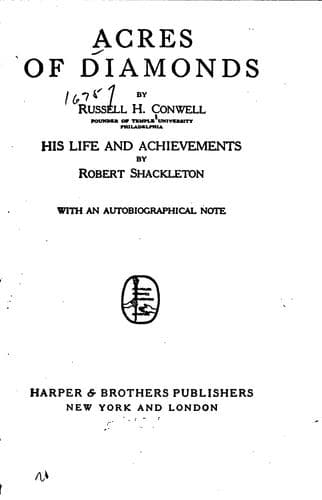
This stirring manifesto shows how to discover everything you need to succeed— where you least expect it.So begins one of the most famous speeches of the twentieth century, a talk that educator and minister Russell H. Conwell delivered before literally thousands of audiences before his death in 1925. In its printed version Acres of Diamonds reached millions of readers around the world. Conwell's great manifesto imparts one extraordinary lesson: All the wealth you could ever dream of, search for, or yearn after—in whatever form you wish for—exists right beneath your own feet. It is a message of determination, unconventional thinking, and positive living that came to influence a generation of motivational literature.The Success Classics edition of Acres of Diamonds also features two rare bonus works: Praying for Money and The Story of "Acres of Diamonds" by journalist Robert Shackleton.
“Attractive to young people.” Yes, one can recognize that to-day, just
as it was recognized in Lexington. And it may be added that he at the
same time attracts older people, too! In this, indeed, lies his power.
He makes his church interesting, his sermons interesting, his
lectures interesting. He is himself interesting! Because of his being
interesting, he gains attention. The attention gained, he inspires.
Biography is more than dates. Dates, after all, are but mile-stones
along the road of life. And the most important fact of Conwell’s life is
that he lived to be eighty-two, working sixteen hours every day for the
good of his fellow-men. He was born on February 15, 1843--born of
poor parents, in a low-roofed cottage in the eastern Berkshires, in
Massachusetts.
“I was born in this room,” he said to me, simply, as we sat together
recently [3] in front of the old fireplace in the principal room of the
little cottage; for he has bought back the rocky farm of his father, and
has retained and restored the little old home. “I was born in this room.
It was bedroom and kitchen. It was poverty.” And his voice sank with a
kind of grimness into silence.
Then he spoke a little of the struggles of those long-past years; and we
went out on the porch, as the evening shadows fell, and looked out
over the valley and stream and hills of his youth, and he told of his
grandmother, and of a young Marylander who had come to the region on
a visit; it was a tale of the impetuous love of those two, of rash
marriage, of the interference of parents, of the fierce rivalry of
another suitor, of an attack on the Marylander’s life, of passionate
hastiness, of unforgivable words, of separation, of lifelong sorrow.
“Why does grandmother cry so often?” he remembers asking when he was a
little boy. And he was told that it was for the husband of her youth.
We went back into the little house, and he showed me the room in which
he first saw John Brown. “I came down early one morning, and saw a huge,
hairy man sprawled upon the bed there--and I was frightened,” he says.
But John Brown did not long frighten him! For he was much at their house
after that, and was so friendly with Russell and his brother that
there was no chance for awe; and it gives a curious side-light on the
character of the stern abolitionist that he actually, with infinite
patience, taught the old horse of the Conwells to go home alone with
the wagon after leaving the boys at school, a mile or more away, and at
school-closing time to trot gently off for them without a driver when
merely faced in that direction and told to go! Conwell remembers how
John Brown, in training it, used patiently to walk beside the horse, and
control its going and its turnings, until it was quite ready to go and
turn entirely by itself.
Reviews
Reviews
No reviews yet
Be the first to share your thoughts on this work.
Join the Discussion
Join the discussion
Sign in to leave a comment or review.
Sign InorCreate an account