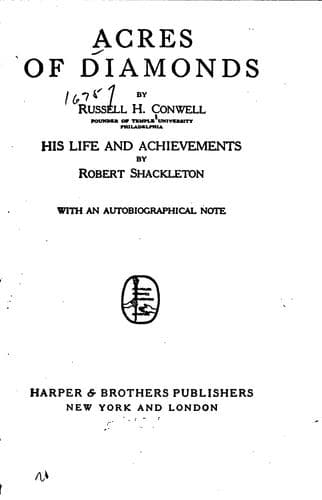
This stirring manifesto shows how to discover everything you need to succeed— where you least expect it.So begins one of the most famous speeches of the twentieth century, a talk that educator and minister Russell H. Conwell delivered before literally thousands of audiences before his death in 1925. In its printed version Acres of Diamonds reached millions of readers around the world. Conwell's great manifesto imparts one extraordinary lesson: All the wealth you could ever dream of, search for, or yearn after—in whatever form you wish for—exists right beneath your own feet. It is a message of determination, unconventional thinking, and positive living that came to influence a generation of motivational literature.The Success Classics edition of Acres of Diamonds also features two rare bonus works: Praying for Money and The Story of "Acres of Diamonds" by journalist Robert Shackleton.
The Conwell house was a station on the Underground Railway, and Russell
Conwell remembers, when a lad, seeing the escaping slaves that his
father had driven across country and temporarily hidden. “Those were
heroic days,” he says, quietly. “And once in a while my father let me
go with him. They were wonderful night drives--the cowering slaves, the
darkness of the road, the caution and the silence and dread of it all.”
This underground route, he remembers, was from Philadelphia to New
Haven, thence to Springfield, where Conwell’s father would take his
charge, and onward to Bellows Falls and Canada.
Conwell tells, too, of meeting Frederick Douglass, the colored orator,
in that little cottage in the hills. “‘I never saw my father,’ Douglass
said one day--his father was a white man--‘and I remember little of my
mother except that once she tried to keep an overseer from whipping me,
and the lash cut across her own face, and her blood fell over me.’
“When John Brown was captured,” Conwell went on, “my father tried to
sell this place to get a little money to send to help his defense. But
he couldn’t sell it, and on the day of the execution we knelt solemnly
here, from eleven to twelve, just praying, praying in silence for the
passing soul of John Brown. And as we prayed we knew that others were
also praying, for a church-bell tolled during that entire hour, and its
awesome boom went sadly sounding over these hills.”
Conwell believes that his real life dates from a happening of the time
of the Civil War--a happening that still looms vivid and intense before
him, and which undoubtedly did deepen and strengthen his strong and
deep nature. Yet the real Conwell was always essentially the same.
Neighborhood tradition still tells of his bravery as a boy and a youth,
of his reckless coasting, his skill as a swimmer and his saving of
lives, his strength and endurance, his plunging out into the darkness of
a wild winter night to save a neighbor’s cattle. His soldiers came home
with tales of his devotion to them, and of how he shared his rations
and his blankets and bravely risked his life; of how he crept off into a
swamp, at imminent peril, to rescue one of his men lost or mired there.
The present Conwell was always Conwell; in fact, he may be traced
through his ancestry, too, for in him are the sturdy virtues, the
bravery, the grim determination, the practicality, of his father; and
romanticism, that comes from his grandmother; and the dreamy qualities
of his mother, who, practical and hardworking New England woman that she
was, was at the same time influenced by an almost startling mysticism.
Reviews
Reviews
No reviews yet
Be the first to share your thoughts on this work.
Join the Discussion
Join the discussion
Sign in to leave a comment or review.
Sign InorCreate an account