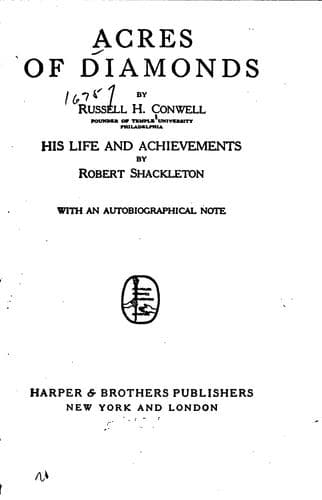
This stirring manifesto shows how to discover everything you need to succeed— where you least expect it.So begins one of the most famous speeches of the twentieth century, a talk that educator and minister Russell H. Conwell delivered before literally thousands of audiences before his death in 1925. In its printed version Acres of Diamonds reached millions of readers around the world. Conwell's great manifesto imparts one extraordinary lesson: All the wealth you could ever dream of, search for, or yearn after—in whatever form you wish for—exists right beneath your own feet. It is a message of determination, unconventional thinking, and positive living that came to influence a generation of motivational literature.The Success Classics edition of Acres of Diamonds also features two rare bonus works: Praying for Money and The Story of "Acres of Diamonds" by journalist Robert Shackleton.
“There was dead silence except for the crackling of the fire. Not a man
cried out. All waited in hopeless expectancy. And then came a mighty
yell from Northerner and Southerner alike, for Johnnie came crawling
out of the end of the covered way--he had actually passed through that
frightful place--and his clothes were ablaze, and he toppled over
and fell into shallow water; and in a few moments he was dragged out,
unconscious, and hurried to a hospital.
“He lingered for a day or so, still unconscious, and then came to
himself and smiled a little as he found that the sword for which he
had given his life had been left beside him. He took it in his arms. He
hugged it to his breast. He gave a few words of final message for me.
And that was all.”
Conwell’s voice had gone thrillingly low as he neared the end, for it
was all so very, very vivid to him, and his eyes had grown tender and
his lips more strong and firm. And he fell silent, thinking of that
long-ago happening, and though he looked down upon the thronging traffic
of Broad Street, it was clear that he did not see it, and that if the
rumbling hubbub of sound meant anything to him it was the rumbling of
the guns of the distant past. When he spoke again it was with a still
tenser tone of feeling.
“When I stood beside the body of John Ring and realized that he had died
for love of me, I made a vow that has formed my life. I vowed that from
that moment I would live not only my own life, but that I would also
live the life of John Ring. And from that moment I have worked sixteen
hours every day--eight for John Ring’s work and eight hours for my own.”
A curious note had come into his voice, as of one who had run the race
and neared the goal, fought the good fight and neared the end.
“Every morning when I rise I look at this sword, or if I am away from
home I think of the sword, and vow anew that another day shall see
sixteen hours of work from me.” And when one comes to know Russell
Conwell one realizes that never did a man work more hard and constantly.
“It was through John Ring and his giving his life through devotion to
me that I became a Christian,” he went on. “This did not come about
immediately, but it came before the war was over, and it came through
faithful Johnnie Ring.”
There is a little lonely cemetery in the Berkshires, a tiny
burying-ground on a wind-swept hill, a few miles from Conwell’s old
home. In this isolated burying-ground bushes and vines and grass grow in
profusion, and a few trees cast a gentle shade; and tree-clad hills go
billowing off for miles and miles in wild and lonely beauty. And in
that lonely little graveyard I found the plain stone that marks the
resting-place of John Ring.
II. THE BEGINNING AT OLD LEXINGTON
Reviews
Reviews
No reviews yet
Be the first to share your thoughts on this work.
Join the Discussion
Join the discussion
Sign in to leave a comment or review.
Sign InorCreate an account