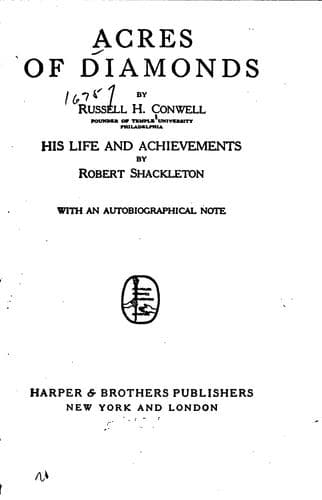
This stirring manifesto shows how to discover everything you need to succeed— where you least expect it.So begins one of the most famous speeches of the twentieth century, a talk that educator and minister Russell H. Conwell delivered before literally thousands of audiences before his death in 1925. In its printed version Acres of Diamonds reached millions of readers around the world. Conwell's great manifesto imparts one extraordinary lesson: All the wealth you could ever dream of, search for, or yearn after—in whatever form you wish for—exists right beneath your own feet. It is a message of determination, unconventional thinking, and positive living that came to influence a generation of motivational literature.The Success Classics edition of Acres of Diamonds also features two rare bonus works: Praying for Money and The Story of "Acres of Diamonds" by journalist Robert Shackleton.
“But for some reason he was devoted to me, and he not only wanted to
enlist, but he also wanted to be in the artillery company of which I was
captain; and I could only take him along as my servant. I didn’t want a
servant, but it was the only way to take poor little Johnnie Ring.
“Johnnie was deeply religious, and would read the Bible every evening
before turning in. In those days I was an atheist, or at least thought
I was, and I used to laugh at Ring, and after a while he took to reading
the Bible outside the tent on account of my laughing at him! But he did
not stop reading it, and his faithfulness to me remained unchanged.
“The scabbard of the sword was too glittering for the regulations”--the
ghost of a smile hovered on Conwell’s lips--“and I could not wear it,
and could only wear a plain one for service and keep this hanging in my
tent on the tent-pole. John Ring used to handle it adoringly, and kept
it polished to brilliancy.--It’s dull enough these many years,” he
added, somberly. “To Ring it represented not only his captain, but the
very glory and pomp of war.
“One day the Confederates suddenly stormed our position near New Berne
and swept through the camp, driving our entire force before them; and
all, including my company, retreated hurriedly across the river,
setting fire to a long wooden bridge as we went over. It soon blazed up
furiously, making a barrier that the Confederates could not pass.
“But, unknown to everybody, and unnoticed, John Ring had dashed back to
my tent. I think he was able to make his way back because he just looked
like a mere boy; but however that was, he got past the Confederates into
my tent and took down, from where it was hanging on the tent-pole, my
bright, gold-scabbarded sword.
“John Ring seized the sword that had long been so precious to him. He
dodged here and there, and actually managed to gain the bridge just
as it was beginning to blaze. He started across. The flames were every
moment getting fiercer, the smoke denser, and now and then, as he
crawled and staggered on, he leaned for a few seconds far over the edge
of the bridge in an effort to get air. Both sides saw him; both sides
watched his terrible progress, even while firing was fiercely kept up
from each side of the river. And then a Confederate officer--he was one
of General Pickett’s officers--ran to the water’s edge and waved a white
handkerchief and the firing ceased.
“‘Tell that boy to come back here!’ he cried. ‘Tell him to come back
here and we will let him go free!’
“He called this out just as Ring was about to enter upon the worst part
of the bridge--the covered part, where there were top and bottom and
sides of blazing wood. The roar of the flames was so close to Ring that
he could not hear the calls from either side of the river, and he pushed
desperately on and disappeared in the covered part.
Reviews
Reviews
No reviews yet
Be the first to share your thoughts on this work.
Join the Discussion
Join the discussion
Sign in to leave a comment or review.
Sign InorCreate an account