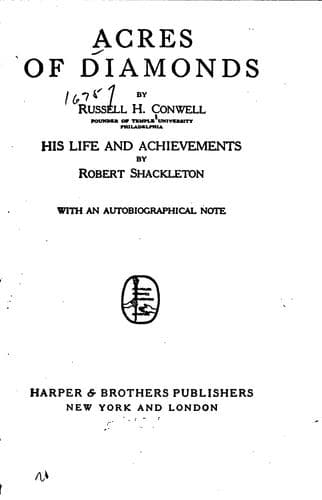
This stirring manifesto shows how to discover everything you need to succeed— where you least expect it.So begins one of the most famous speeches of the twentieth century, a talk that educator and minister Russell H. Conwell delivered before literally thousands of audiences before his death in 1925. In its printed version Acres of Diamonds reached millions of readers around the world. Conwell's great manifesto imparts one extraordinary lesson: All the wealth you could ever dream of, search for, or yearn after—in whatever form you wish for—exists right beneath your own feet. It is a message of determination, unconventional thinking, and positive living that came to influence a generation of motivational literature.The Success Classics edition of Acres of Diamonds also features two rare bonus works: Praying for Money and The Story of "Acres of Diamonds" by journalist Robert Shackleton.
“Diamonds! What do you want with diamonds?” “Why, I wish to be immensely
rich.” “Well, then, go along and find them. That is all you have to do;
go and find them, and then you have them.” “But I don’t know where to
go.” “Well, if you will find a river that runs through white sands,
between high mountains, in those white sands you will always find
diamonds.” “I don’t believe there is any such river.” “Oh yes, there are
plenty of them. All you have to do is to go and find them, and then you
have them.” Said Ali Hafed, “I will go.”
So he sold his farm, collected his money, left his family in charge of
a neighbor, and away he went in search of diamonds. He began his search,
very properly to my mind, at the Mountains of the Moon. Afterward he
came around into Palestine, then wandered on into Europe, and at last
when his money was all spent and he was in rags, wretchedness, and
poverty, he stood on the shore of that bay at Barcelona, in Spain, when
a great tidal wave came rolling in between the pillars of Hercules, and
the poor, afflicted, suffering, dying man could not resist the awful
temptation to cast himself into that incoming tide, and he sank beneath
its foaming crest, never to rise in this life again.
When that old guide had told me that awfully sad story he stopped the
camel I was riding on and went back to fix the baggage that was coming
off another camel, and I had an opportunity to muse over his story while
he was gone. I remember saying to myself, “Why did he reserve that
story for his ‘particular friends’?” There seemed to be no beginning, no
middle, no end, nothing to it. That was the first story I had ever heard
told in my life, and would be the first one I ever read, in which the
hero was killed in the first chapter. I had but one chapter of that
story, and the hero was dead.
When the guide came back and took up the halter of my camel, he went
right ahead with the story, into the second chapter, just as though
there had been no break. The man who purchased Ali Hafed’s farm one day
led his camel into the garden to drink, and as that camel put its nose
into the shallow water of that garden brook, Ali Hafed’s successor
noticed a curious flash of light from the white sands of the stream. He
pulled out a black stone having an eye of light reflecting all the hues
of the rainbow. He took the pebble into the house and put it on the
mantel which covers the central fires, and forgot all about it.
A few days later this same old priest came in to visit Ali Hafed’s
successor, and the moment he opened that drawing-room door he saw that
flash of light on the mantel, and he rushed up to it, and shouted:
“Here is a diamond! Has Ali Hafed returned?” “Oh no, Ali Hafed has not
returned, and that is not a diamond. That is nothing but a stone we
found right out here in our own garden.” “But,” said the priest, “I
tell you I know a diamond when I see it. I know positively that is a
diamond.”
Public-domain text, read in full here on John Shaqi.
Reviews
Reviews
No reviews yet
Be the first to share your thoughts on this work.
Join the Discussion
Join the discussion
Sign in to leave a comment or review.
Sign InorCreate an account