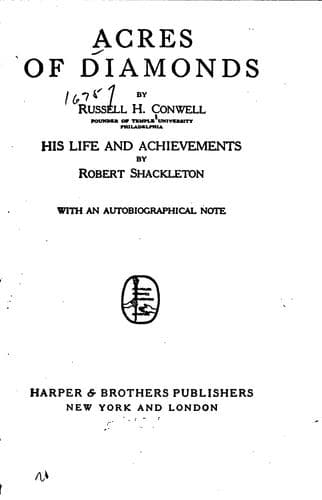
This stirring manifesto shows how to discover everything you need to succeed— where you least expect it.So begins one of the most famous speeches of the twentieth century, a talk that educator and minister Russell H. Conwell delivered before literally thousands of audiences before his death in 1925. In its printed version Acres of Diamonds reached millions of readers around the world. Conwell's great manifesto imparts one extraordinary lesson: All the wealth you could ever dream of, search for, or yearn after—in whatever form you wish for—exists right beneath your own feet. It is a message of determination, unconventional thinking, and positive living that came to influence a generation of motivational literature.The Success Classics edition of Acres of Diamonds also features two rare bonus works: Praying for Money and The Story of "Acres of Diamonds" by journalist Robert Shackleton.
Then together they rushed out into that old garden and stirred up
the white sands with their fingers, and lo! there came up other more
beautiful and valuable gems than the first. “Thus,” said the guide
to me, and, friends, it is historically true, “was discovered the
diamond-mine of Golconda, the most magnificent diamond-mine in all the
history of mankind, excelling the Kimberly itself. The Kohinoor, and the
Orloff of the crown jewels of England and Russia, the largest on earth,
came from that mine.”
When that old Arab guide told me the second chapter of his story, he
then took off his Turkish cap and swung it around in the air again to
get my attention to the moral. Those Arab guides have morals to their
stories, although they are not always moral. As he swung his hat, he
said to me, “Had Ali Hafed remained at home and dug in his own cellar,
or underneath his own wheat-fields, or in his own garden, instead of
wretchedness, starvation, and death by suicide in a strange land, he
would have had ‘acres of diamonds.’ For every acre of that old farm,
yes, every shovelful, afterward revealed gems which since have decorated
the crowns of monarchs.”
When he had added the moral to his story I saw why he reserved it for
“his particular friends.” But I did not tell him I could see it. It was
that mean old Arab’s way of going around a thing like a lawyer, to
say indirectly what he did not dare say directly, that “in his private
opinion there was a certain young man then traveling down the Tigris
River that might better be at home in America.” I did not tell him I
could see that, but I told him his story reminded me of one, and I told
it to him quick, and I think I will tell it to you.
I told him of a man out in California in 1847 who owned a ranch. He
heard they had discovered gold in southern California, and so with a
passion for gold he sold his ranch to Colonel Sutter, and away he went,
never to come back. Colonel Sutter put a mill upon a stream that ran
through that ranch, and one day his little girl brought some wet sand
from the raceway into their home and sifted it through her fingers
before the fire, and in that falling sand a visitor saw the first
shining scales of real gold that were ever discovered in California. The
man who had owned that ranch wanted gold, and he could have secured it
for the mere taking. Indeed, thirty-eight millions of dollars has
been taken out of a very few acres since then. About eight years ago I
delivered this lecture in a city that stands on that farm, and they
told me that a one-third owner for years and years had been getting one
hundred and twenty dollars in gold every fifteen minutes, sleeping or
waking, without taxation. You and I would enjoy an income like that--if
we didn’t have to pay an income tax.
Reviews
Reviews
No reviews yet
Be the first to share your thoughts on this work.
Join the Discussion
Join the discussion
Sign in to leave a comment or review.
Sign InorCreate an account