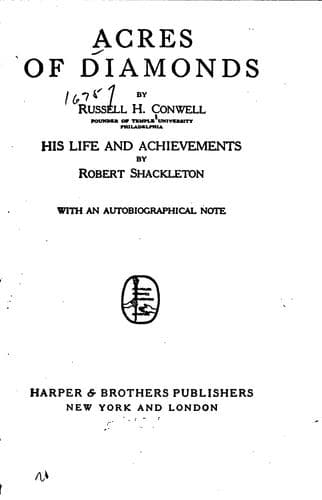
This stirring manifesto shows how to discover everything you need to succeed— where you least expect it.So begins one of the most famous speeches of the twentieth century, a talk that educator and minister Russell H. Conwell delivered before literally thousands of audiences before his death in 1925. In its printed version Acres of Diamonds reached millions of readers around the world. Conwell's great manifesto imparts one extraordinary lesson: All the wealth you could ever dream of, search for, or yearn after—in whatever form you wish for—exists right beneath your own feet. It is a message of determination, unconventional thinking, and positive living that came to influence a generation of motivational literature.The Success Classics edition of Acres of Diamonds also features two rare bonus works: Praying for Money and The Story of "Acres of Diamonds" by journalist Robert Shackleton.
And here is an excellent example of how dreaming great dreams may go
hand-in-hand with winning superb results. For that little struggling
congregation now owns and occupies a great new church building that
seats more people than any other Protestant church in America--and Dr.
Conwell fills it!
III. STORY OF THE FIFTY-SEVEN CENTS
AT every point in Conwell’s life one sees that he wins through his
wonderful personal influence on old and young. Every step forward, every
triumph achieved, comes not alone from his own enthusiasm, but because
of his putting that enthusiasm into others. And when I learned how it
came about that the present church buildings were begun, it was another
of those marvelous tales of fact that are stranger than any imagination
could make them. And yet the tale was so simple and sweet and sad and
unpretending.
When Dr. Conwell first assumed charge of the little congregation that
led him to Philadelphia it was really a little church both in its
numbers and in the size of the building that it occupied, but it quickly
became so popular under his leadership that the church services and
Sunday-school services were alike so crowded that there was no room for
all who came, and always there were people turned from the doors.
One afternoon a little girl, who had eagerly wished to go, turned back
from the Sunday-school door, crying bitterly because they had told her
that there was no more room. But a tall, black-haired man met her and
noticed her tears and, stopping, asked why it was that she was crying,
and she sobbingly replied that it was because they could not let her
into the Sunday-school.
“I lifted her to my shoulder,” says Dr. Conwell, in telling of this; for
after hearing the story elsewhere I asked him to tell it to me himself,
for it seemed almost too strange to be true. “I lifted her to my
shoulder”--and one realizes the pretty scene it must have made for the
little girl to go through the crowd of people, drying her tears and
riding proudly on the shoulders of the kindly, tall, dark man! “I said
to her that I would take her in, and I did so, and I said to her that we
should some day have a room big enough for all who should come. And when
she went home she told her parents--I only learned this afterward--that
she was going to save money to help build the larger church and
Sunday-school that Dr. Conwell wanted! Her parents pleasantly humored
her in the idea and let her run errands and do little tasks to earn
pennies, and she began dropping the pennies into her bank.”
“She was a lovable little thing--but in only a few weeks after that she
was taken suddenly ill and died; and at the funeral her father told
me, quietly, of how his little girl had been saving money for a
building-fund. And there, at the funeral, he handed me what she had
saved--just fifty-seven cents in pennies.”
Reviews
Reviews
No reviews yet
Be the first to share your thoughts on this work.
Join the Discussion
Join the discussion
Sign in to leave a comment or review.
Sign InorCreate an account