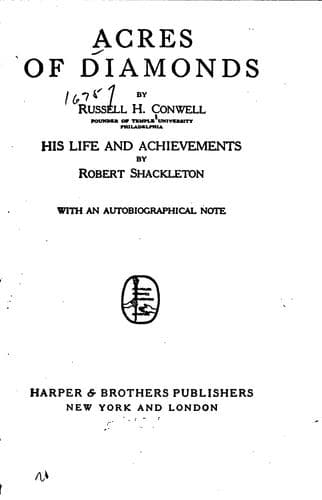
This stirring manifesto shows how to discover everything you need to succeed— where you least expect it.So begins one of the most famous speeches of the twentieth century, a talk that educator and minister Russell H. Conwell delivered before literally thousands of audiences before his death in 1925. In its printed version Acres of Diamonds reached millions of readers around the world. Conwell's great manifesto imparts one extraordinary lesson: All the wealth you could ever dream of, search for, or yearn after—in whatever form you wish for—exists right beneath your own feet. It is a message of determination, unconventional thinking, and positive living that came to influence a generation of motivational literature.The Success Classics edition of Acres of Diamonds also features two rare bonus works: Praying for Money and The Story of "Acres of Diamonds" by journalist Robert Shackleton.
“Week by week I preached there”--how strange, now, to think of William
Dean Howells and the colonel-preacher!--“and after a while the church
was completed, and in that very church, there in Lexington, I was
ordained a minister.”
A marvelous thing, all this, even without considering the marvelous
heights that Conwell has since attained--a marvelous thing, an
achievement of positive romance! That little church stood for American
bravery and initiative and self-sacrifice and romanticism in a way that
well befitted good old Lexington.
To leave a large and overflowing law practice and take up the ministry
at a salary of six hundred dollars a year seemed to the relatives of
Conwell’s wife the extreme of foolishness, and they did not hesitate
so to express themselves. Naturally enough, they did not have Conwell’s
vision. Yet he himself was fair enough to realize and to admit that
there was a good deal of fairness in their objections; and so he said to
the congregation that, although he was quite ready to come for the six
hundred dollars a year, he expected them to double his salary as soon as
he doubled the church membership. This seemed to them a good deal like a
joke, but they answered in perfect earnestness that they would be quite
willing to do the doubling as soon as he did the doubling, and in less
than a year the salary was doubled accordingly.
I asked him if he had found it hard to give up the lucrative law for
a poor ministry, and his reply gave a delightful impression of his
capacity for humorous insight into human nature, for he said, with a
genial twinkle:
“Oh yes, it was a wrench; but there is a sort of romance of
self-sacrifice, you know. I rather suppose the old-time martyrs rather
enjoyed themselves in being martyrs!”
Conwell did not stay very long in Lexington. A struggling little church
in Philadelphia heard of what he was doing, and so an old deacon went up
to see and hear him, and an invitation was given; and as the Lexington
church seemed to be prosperously on its feet, and the needs of the
Philadelphia body keenly appealed to Conwell’s imagination, a change was
made, and at a salary of eight hundred dollars a year he went, in
1882, to the little struggling Philadelphia congregation, and of that
congregation he is still pastor--only, it ceased to be a struggling
congregation a great many years ago! And long ago it began paying him
more thousands every year than at first it gave him hundreds.
Dreamer as Conwell always is in connection with his immense
practicality, and moved as he is by the spiritual influences of life,
it is more than likely that not only did Philadelphia’s need appeal,
but also the fact that Philadelphia, as a city, meant much to him, for,
coming North, wounded from a battle-field of the Civil War, it was in
Philadelphia that he was cared for until his health and strength were
recovered. Thus it came that Philadelphia had early become dear to him.
Public-domain text, read in full here on John Shaqi.
Reviews
Reviews
No reviews yet
Be the first to share your thoughts on this work.
Join the Discussion
Join the discussion
Sign in to leave a comment or review.
Sign InorCreate an account