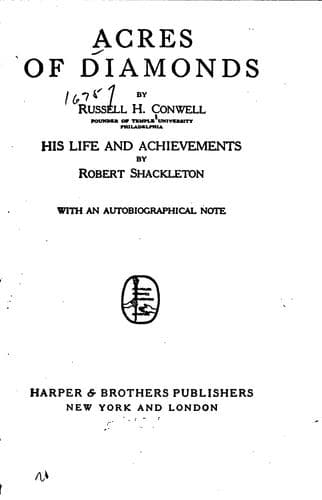
This stirring manifesto shows how to discover everything you need to succeed— where you least expect it.So begins one of the most famous speeches of the twentieth century, a talk that educator and minister Russell H. Conwell delivered before literally thousands of audiences before his death in 1925. In its printed version Acres of Diamonds reached millions of readers around the world. Conwell's great manifesto imparts one extraordinary lesson: All the wealth you could ever dream of, search for, or yearn after—in whatever form you wish for—exists right beneath your own feet. It is a message of determination, unconventional thinking, and positive living that came to influence a generation of motivational literature.The Success Classics edition of Acres of Diamonds also features two rare bonus works: Praying for Money and The Story of "Acres of Diamonds" by journalist Robert Shackleton.
Doesn’t it seem like a fairy tale! But then this man has all his life
been making fairy tales into realities. He inspired the child. He
inspired the trustees. He inspired the owner of the land. He inspired
the people.
The building of the great church--the Temple Baptist Church, as it is
termed--was a great undertaking for the congregation; even though it had
been swiftly growing from the day of Dr. Conwell’s taking charge of it,
it was something far ahead of what, except in the eyes of an enthusiast,
they could possibly complete and pay for and support. Nor was it an easy
task.
Ground was broken for the building in 1889, in 1891 it was opened for
worship, and then came years of raising money to clear it. But it was
long ago placed completely out of debt, and with only a single large
subscription--one of ten thousand dollars--for the church is not in a
wealthy neighborhood, nor is the congregation made up of the great and
rich.
The church is built of stone, and its interior is a great amphitheater.
Special attention has been given to fresh air and light; there
is nothing of the dim, religious light that goes with medieval
churchliness. Behind the pulpit are tiers of seats for the great chorus
choir. There is a large organ. The building is peculiarly adapted for
hearing and seeing, and if it is not, strictly speaking, beautiful in
itself, it is beautiful when it is filled with encircling rows of men
and women.
Man of feeling that he is, and one who appreciates the importance of
symbols, Dr. Conwell had a heart of olive-wood built into the front
of the pulpit, for the wood was from an olive-tree in the Garden of
Gethsemane. And the amber-colored tiles in the inner walls of the church
bear, under the glaze, the names of thousands of his people; for every
one, young or old, who helped in the building, even to the giving of a
single dollar, has his name inscribed there. For Dr. Conwell wished to
show that it is not only the house of the Lord, but also, in a keenly
personal sense, the house of those who built it.
The church has a possible seating capacity of 4,200, although only 3,135
chairs have been put in it, for it has been the desire not to crowd the
space needlessly. There is also a great room for the Sunday-school,
and extensive rooms for the young men’s association, the young
women’s association, and for a kitchen, for executive offices, for
meeting-places for church officers and boards and committees. It is a
spacious and practical and complete church home, and the people feel at
home there.
“You see again,” said Dr. Conwell, musingly, “the advantage of aiming at
big things. That building represents $109,000 above ground. It is
free from debt. Had we built a small church, it would now be heavily
mortgaged.”
IV. HIS POWER AS ORATOR AND PREACHER
Reviews
Reviews
No reviews yet
Be the first to share your thoughts on this work.
Join the Discussion
Join the discussion
Sign in to leave a comment or review.
Sign InorCreate an account