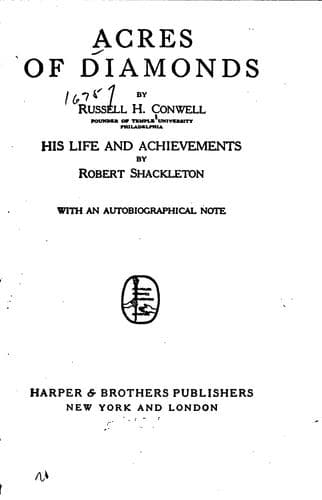
This stirring manifesto shows how to discover everything you need to succeed— where you least expect it.So begins one of the most famous speeches of the twentieth century, a talk that educator and minister Russell H. Conwell delivered before literally thousands of audiences before his death in 1925. In its printed version Acres of Diamonds reached millions of readers around the world. Conwell's great manifesto imparts one extraordinary lesson: All the wealth you could ever dream of, search for, or yearn after—in whatever form you wish for—exists right beneath your own feet. It is a message of determination, unconventional thinking, and positive living that came to influence a generation of motivational literature.The Success Classics edition of Acres of Diamonds also features two rare bonus works: Praying for Money and The Story of "Acres of Diamonds" by journalist Robert Shackleton.
EVEN as a young man Conwell won local fame as an orator. At the
outbreak of the Civil War he began making patriotic speeches that gained
enlistments. After going to the front he was sent back home for a
time, on furlough, to make more speeches to draw more recruits, for
his speeches were so persuasive, so powerful, so full of homely and
patriotic feeling, that the men who heard them thronged into the
ranks. And as a preacher he uses persuasion, power, simple and homely
eloquence, to draw men to the ranks of Christianity.
He is an orator born, and has developed this inborn power by the hardest
of study and thought and practice. He is one of those rare men who
always seize and hold the attention. When he speaks, men listen. It is
quality, temperament, control--the word is immaterial, but the fact is
very material indeed.
Some quarter of a century ago Conwell published a little book for
students on the study and practice of oratory. That “clear-cut
articulation is the charm of eloquence” is one of his insisted-upon
statements, and it well illustrates the lifelong practice of the man
himself, for every word as he talks can be heard in every part of a
large building, yet always he speaks without apparent effort. He avoids
“elocution.” His voice is soft-pitched and never breaks, even now when
he is over seventy, because, so he explains it, he always speaks in his
natural voice. There is never a straining after effect.
“A speaker must possess a large-hearted regard for the welfare of
his audience,” he writes, and here again we see Conwell explaining
Conwellism. “Enthusiasm invites enthusiasm,” is another of his points
of importance; and one understands that it is by deliberate purpose,
and not by chance, that he tries with such tremendous effort to put
enthusiasm into his hearers with every sermon and every lecture that he
delivers.
“It is easy to raise a laugh, but dangerous, for it is the greatest test
of an orator’s control of his audience to be able to land them again on
the solid earth of sober thinking.” I have known him at the very end
of a sermon have a ripple of laughter sweep freely over the entire
congregation, and then in a moment he has every individual under his
control, listening soberly to his words.
He never fears to use humor, and it is always very simple and obvious
and effective. With him even a very simple pun may be used, not only
with-out taking away from the strength of what he is saying, but with a
vivid increase of impressiveness. And when he says something funny it
is in such a delightful and confidential way, with such a genial, quiet,
infectious humorousness, that his audience is captivated. And they never
think that he is telling something funny of his own; it seems, such is
the skill of the man, that he is just letting them know of something
humorous that they are to enjoy with him.
Reviews
Reviews
No reviews yet
Be the first to share your thoughts on this work.
Join the Discussion
Join the discussion
Sign in to leave a comment or review.
Sign InorCreate an account