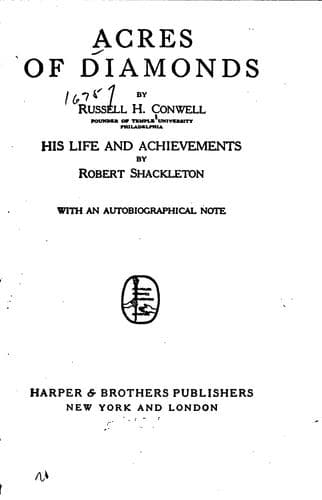
This stirring manifesto shows how to discover everything you need to succeed— where you least expect it.So begins one of the most famous speeches of the twentieth century, a talk that educator and minister Russell H. Conwell delivered before literally thousands of audiences before his death in 1925. In its printed version Acres of Diamonds reached millions of readers around the world. Conwell's great manifesto imparts one extraordinary lesson: All the wealth you could ever dream of, search for, or yearn after—in whatever form you wish for—exists right beneath your own feet. It is a message of determination, unconventional thinking, and positive living that came to influence a generation of motivational literature.The Success Classics edition of Acres of Diamonds also features two rare bonus works: Praying for Money and The Story of "Acres of Diamonds" by journalist Robert Shackleton.
Music is one of Conwell’s strongest aids. He sings himself; sings as if
he likes to sing, and often finds himself leading the singing--usually
so, indeed, at the prayer-meetings, and often, in effect, at the church
services.
I remember at one church service that the choir-leader was standing
in front of the massed choir ostensibly leading the singing, but that
Conwell himself, standing at the rear of the pulpit platform, with his
eyes on his hymn-book, silently swaying a little with the music and
unconsciously beating time as he swayed, was just as unconsciously the
real leader, for it was he whom the congregation were watching and with
him that they were keeping time! He never suspected it; he was merely
thinking along with the music; and there was such a look of contagious
happiness on his face as made every one in the building similarly happy.
For he possesses a mysterious faculty of imbuing others with his own
happiness.
Not only singers, but the modern equivalent of psaltery and tabret and
cymbals, all have their place in Dr. Conwell’s scheme of church service;
for there may be a piano, and there may even be a trombone, and there is
a great organ to help the voices, and at times there are chiming bells.
His musical taste seems to tend toward the thunderous--or perhaps it
is only that he knows there are times when people like to hear the
thunderous and are moved by it.
And how the choir themselves like it! They occupy a great curving
space behind the pulpit, and put their hearts into song. And as the
congregation disperse and the choir filter down, sometimes they are
still singing and some of them continue to sing as they go slowly out
toward the doors. They are happy--Conwell himself is happy--all the
congregation are happy. He makes everybody feel happy in coming to
church; he makes the church attractive just as Howells was so long ago
told that he did in Lexington.
And there is something more than happiness; there is a sense of ease, of
comfort, of general joy, that is quite unmistakable. There is nothing of
stiffness or constraint. And with it all there is full reverence. It
is no wonder that he is accustomed to fill every seat of the great
building.
His gestures are usually very simple. Now and then, when he works up to
emphasis, he strikes one fist in the palm of the other hand. When he is
through you do not remember that he has made any gestures at all, but
the sound of his voice remains with you, and the look of his wonderful
eyes. And though he is past the threescore years and ten, he looks out
over his people with eyes that still have the veritable look of youth.
Reviews
Reviews
No reviews yet
Be the first to share your thoughts on this work.
Join the Discussion
Join the discussion
Sign in to leave a comment or review.
Sign InorCreate an account