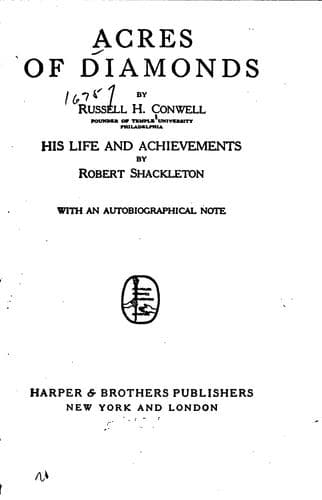
This stirring manifesto shows how to discover everything you need to succeed— where you least expect it.So begins one of the most famous speeches of the twentieth century, a talk that educator and minister Russell H. Conwell delivered before literally thousands of audiences before his death in 1925. In its printed version Acres of Diamonds reached millions of readers around the world. Conwell's great manifesto imparts one extraordinary lesson: All the wealth you could ever dream of, search for, or yearn after—in whatever form you wish for—exists right beneath your own feet. It is a message of determination, unconventional thinking, and positive living that came to influence a generation of motivational literature.The Success Classics edition of Acres of Diamonds also features two rare bonus works: Praying for Money and The Story of "Acres of Diamonds" by journalist Robert Shackleton.
Like all great men, he not only does big things, but keeps in touch with
myriad details. When his assistant, announcing the funeral of an old
member, hesitates about the street and number and says that they can
be found in the telephone directory, Dr. Conwell’s deep voice breaks
quietly in with, “Such a number [giving it], Dauphin Street”--quietly,
and in a low tone, yet every one in the church hears distinctly every
syllable of that low voice.
His fund of personal anecdote, or personal reminiscence, is constant and
illustrative in his preaching, just as it is when he lectures, and
the reminiscences sweep through many years, and at times are really
startling in the vivid and homelike pictures they present of the famous
folk of the past that he knew.
One Sunday evening he made an almost casual reference to the time when
he first met Garfield, then a candidate for the Presidency. “I asked
Major McKinley, whom I had met in Washington, and whose home was
in northern Ohio, as was that of Mr. Garfield, to go with me to Mr.
Garfield’s home and introduce me. When we got there, a neighbor had to
find him. ‘Jim! Jim!’ he called. You see, Garfield was just plain Jim to
his old neighbors. It’s hard to recognize a hero over your back fence!”
He paused a moment for the appreciative ripple to subside, and went on:
“We three talked there together”--what a rare talking that must have
been-McKinley, Garfield, and Conwell--“we talked together, and after a
while we got to the subject of hymns, and those two great men both told
me how deeply they loved the old hymn, ‘The Old-Time Religion.’ Garfield
especially loved it, so he told us, because the good old man who brought
him up as a boy and to whom he owed such gratitude, used to sing it at
the pasture bars outside of the boy’s window every morning, and young
Jim knew, whenever he heard that old tune, that it meant it was time
for him to get up. He said that he had heard the best concerts and the
finest operas in the world, but had never heard anything he loved as he
still loved ‘The Old-Time Religion.’ I forget what reason there was
for McKinley’s especially liking it, but he, as did Garfield, liked it
immensely.”
What followed was a striking example of Conwell’s intentness on losing
no chance to fix an impression on his hearers’ minds, and at the same
time it was a really astonishing proof of his power to move and sway.
For a new expression came over his face, and he said, as if the idea had
only at that moment occurred to him--as it most probably had--“I think
it’s in our hymnal!” And in a moment he announced the number, and the
great organ struck up, and every person in the great church every man,
woman, and child--joined in the swinging rhythm of verse after verse,
as if they could never tire, of “The Old-Time Religion.” It is a simple
melody--barely more than a single line of almost monotone music:
Reviews
Reviews
No reviews yet
Be the first to share your thoughts on this work.
Join the Discussion
Join the discussion
Sign in to leave a comment or review.
Sign InorCreate an account