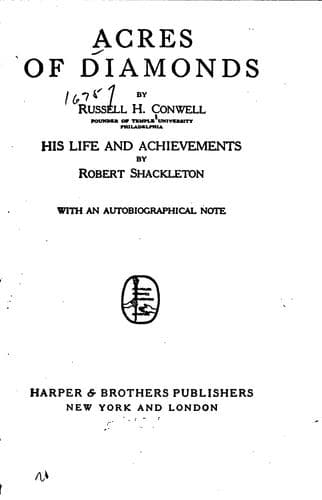
This stirring manifesto shows how to discover everything you need to succeed— where you least expect it.So begins one of the most famous speeches of the twentieth century, a talk that educator and minister Russell H. Conwell delivered before literally thousands of audiences before his death in 1925. In its printed version Acres of Diamonds reached millions of readers around the world. Conwell's great manifesto imparts one extraordinary lesson: All the wealth you could ever dream of, search for, or yearn after—in whatever form you wish for—exists right beneath your own feet. It is a message of determination, unconventional thinking, and positive living that came to influence a generation of motivational literature.The Success Classics edition of Acres of Diamonds also features two rare bonus works: Praying for Money and The Story of "Acres of Diamonds" by journalist Robert Shackleton.
_It was good enough for mother and it’s good enough for me!
It was good on the fiery furnace and it’s good enough for me!_
Thus it went on, with never-wearying iteration, and each time with the
refrain, more and more rhythmic and swaying:
_The old-time religion,
The old-time religion,
The old-time religion--
It’s good enough for me!_
That it was good for the Hebrew children, that it was good for Paul and
Silas, that it will help you when you’re dying, that it will show the
way to heaven--all these and still other lines were sung, with a sort
of wailing softness, a curious monotone, a depth of earnestness. And the
man who had worked this miracle of control by evoking out of the past
his memory of a meeting with two of the vanished great ones of the
earth, stood before his people, leading them, singing with them, his
eyes aglow with an inward light. His magic had suddenly set them into
the spirit of the old camp-meeting days, the days of pioneering and
hardship, when religion meant so much to everybody, and even those who
knew nothing of such things felt them, even if but vaguely. Every heart
was moved and touched, and that old tune will sing in the memory of all
who thus heard it and sung it as long as they live.
V. GIFT FOR INSPIRING OTHERS
THE constant earnestness of Conwell, his desire to let no chance slip by
of helping a fellowman, puts often into his voice, when he preaches, a
note of eagerness, of anxiety. But when he prays, when he turns to God,
his manner undergoes a subtle and unconscious change. A load has slipped
off his shoulders and has been assumed by a higher power. Into his
bearing, dignified though it was, there comes an unconscious increase of
the dignity. Into his voice, firm as it was before, there comes a deeper
note of firmness. He is apt to fling his arms widespread as he prays,
in a fine gesture that he never uses at other times, and he looks upward
with the dignity of a man who, talking to a higher being, is proud of
being a friend and confidant. One does not need to be a Christian to
appreciate the beauty and fineness of Conwell’s prayers.
He is likely at any time to do the unexpected, and he is so great a
man and has such control that whatever he does seems to everybody a
perfectly natural thing. His sincerity is so evident, and whatever
he does is done so simply and naturally, that it is just a matter of
course.
I remember, during one church service, while the singing was going on,
that he suddenly rose from his chair and, kneeling beside it, on the
open pulpit, with his back to the congregation, remained in that posture
for several minutes. No one thought it strange. I was likely enough the
only one who noticed it. His people are used to his sincerities. And
this time it was merely that he had a few words to say quietly to God
and turned aside for a few moments to say them.
Reviews
Reviews
No reviews yet
Be the first to share your thoughts on this work.
Join the Discussion
Join the discussion
Sign in to leave a comment or review.
Sign InorCreate an account