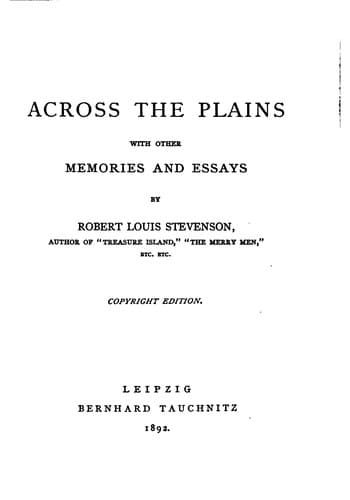
Across the Plains, with Other Memories and EssaysStevenson, Robert Louis
General
Across the Plains, with Other Memories and Essays
Stevenson, Robert Louis
Essays; Monterey (Calif.) -- Description and travel; West (U.S.) -- Description and travel
incessant chirp of grasshoppers—a noise like the winding up of countless
clocks and watches, which began after a while to seem proper to that
land.
To one hurrying through by steam there was a certain exhilaration in this
spacious vacancy, this greatness of the air, this discovery of the whole
arch of heaven, this straight, unbroken, prison-line of the horizon. Yet
one could not but reflect upon the weariness of those who passed by there
in old days, at the foot’s pace of oxen, painfully urging their teams,
and with no landmark but that unattainable evening sun for which they
steered, and which daily fled them by an equal stride. They had nothing,
it would seem, to overtake; nothing by which to reckon their advance; no
sight for repose or for encouragement; but stage after stage, only the
dead green waste under foot, and the mocking, fugitive horizon. But the
eye, as I have been told, found differences even here; and at the worst
the emigrant came, by perseverance, to the end of his toil. It is the
settlers, after all, at whom we have a right to marvel. Our
consciousness, by which we live, is itself but the creature of variety.
Upon what food does it subsist in such a land? What livelihood can repay
a human creature for a life spent in this huge sameness? He is cut off
from books, from news, from company, from all that can relieve existence
but the prosecution of his affairs. A sky full of stars is the most
varied spectacle that he can hope. He may walk five miles and see
nothing; ten, and it is as though he had not moved; twenty, and still he
is in the midst of the same great level, and has approached no nearer to
the one object within view, the flat horizon which keeps pace with his
advance. We are full at home of the question of agreeable wall-papers,
and wise people are of opinion that the temper may be quieted by sedative
surroundings. But what is to be said of the Nebraskan settler? His is a
wall-paper with a vengeance—one quarter of the universe laid bare in all
its gauntness.
His eye must embrace at every glance the whole seeming concave of the
visible world; it quails before so vast an outlook, it is tortured by
distance; yet there is no rest or shelter till the man runs into his
cabin, and can repose his sight upon things near at hand. Hence, I am
told, a sickness of the vision peculiar to these empty plains.
Public-domain text, read in full here on John Shaqi.
Reviews
Reviews
No reviews yet
Be the first to share your thoughts on this work.
Join the Discussion
Join the discussion
Sign in to leave a comment or review.
Sign InorCreate an account