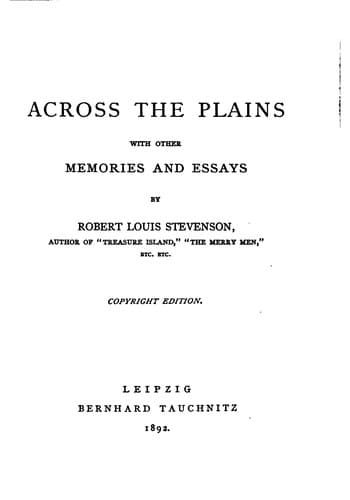
Across the Plains, with Other Memories and EssaysStevenson, Robert Louis
General
Across the Plains, with Other Memories and Essays
Stevenson, Robert Louis
Essays; Monterey (Calif.) -- Description and travel; West (U.S.) -- Description and travel
epileptic fits, and though, of course, there were not wanting some to
help him, it was rather superstitious terror than sympathy that his case
evoked among his fellow-passengers. “Oh, I hope he’s not going to die!”
cried a woman; “it would be terrible to have a dead body!” And there was
a very general movement to leave the man behind at the next station.
This, by good fortune, the conductor negatived.
There was a good deal of story-telling in some quarters; in others,
little but silence. In this society, more than any other that ever I was
in, it was the narrator alone who seemed to enjoy the narrative. It was
rarely that any one listened for the listening. If he lent an ear to
another man’s story, it was because he was in immediate want of a hearer
for one of his own. Food and the progress of the train were the subjects
most generally treated; many joined to discuss these who otherwise would
hold their tongues. One small knot had no better occupation than to worm
out of me my name; and the more they tried, the more obstinately fixed I
grew to baffle them. They assailed me with artful questions and
insidious offers of correspondence in the future; but I was perpetually
on my guard, and parried their assaults with inward laughter. I am sure
Dubuque would have given me ten dollars for the secret. He owed me far
more, had he understood life, for thus preserving him a lively interest
throughout the journey. I met one of my fellow-passengers months after,
driving a street tramway car in San Francisco; and, as the joke was now
out of season, told him my name without subterfuge. You never saw a man
more chapfallen. But had my name been Demogorgon, after so prolonged a
mystery he had still been disappointed.
There were no emigrants direct from Europe—save one German family and a
knot of Cornish miners who kept grimly by themselves, one reading the New
Testament all day long through steel spectacles, the rest discussing
privately the secrets of their old-world, mysterious race. Lady Hester
Stanhope believed she could make something great of the Cornish; for my
part, I can make nothing of them at all. A division of races, older and
more original than that of Babel, keeps this close, esoteric family apart
from neighbouring Englishmen. Not even a Red Indian seems more foreign
in my eyes. This is one of the lessons of travel—that some of the
strangest races dwell next door to you at home.
Public-domain text, read in full here on John Shaqi.
Reviews
Reviews
No reviews yet
Be the first to share your thoughts on this work.
Join the Discussion
Join the discussion
Sign in to leave a comment or review.
Sign InorCreate an account