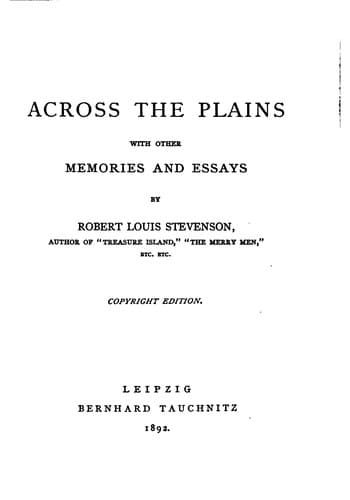
Across the Plains, with Other Memories and EssaysStevenson, Robert Louis
General
Across the Plains, with Other Memories and Essays
Stevenson, Robert Louis
Essays; Monterey (Calif.) -- Description and travel; West (U.S.) -- Description and travel
my youth in the midst of other and (as I fondly thought) more gifted
students. All was vain: that he had passed a riotous nonage, that he was
a zealot, that he twice displayed (compared with his grotesque
companions) some tincture of soldierly resolution and even of military
common sense, and that he figured memorably in the scene on Magus Muir,
so much and no more could I make out. But whenever I cast my eyes
backward, it is to see him like a landmark on the plains of history,
sitting with his cloak about his mouth, inscrutable. How small a thing
creates an immortality! I do not think he can have been a man entirely
commonplace; but had he not thrown his cloak about his mouth, or had the
witnesses forgot to chronicle the action, he would not thus have haunted
the imagination of my boyhood, and to-day he would scarce delay me for a
paragraph. An incident, at once romantic and dramatic, which at once
awakes the judgment and makes a picture for the eye, how little do we
realise its perdurable power! Perhaps no one does so but the author,
just as none but he appreciates the influence of jingling words; so that
he looks on upon life, with something of a covert smile, seeing people
led by what they fancy to be thoughts and what are really the accustomed
artifices of his own trade, or roused by what they take to be principles
and are really picturesque effects. In a pleasant book about a
school-class club, Colonel Fergusson has recently told a little anecdote.
A “Philosophical Society” was formed by some Academy boys—among them,
Colonel Fergusson himself, Fleeming Jenkin, and Andrew Wilson, the
Christian Buddhist and author of _The Abode of Snow_. Before these
learned pundits, one member laid the following ingenious problem: “What
would be the result of putting a pound of potassium in a pot of porter?”
“I should think there would be a number of interesting bi-products,” said
a smatterer at my elbow; but for me the tale itself has a bi-product, and
stands as a type of much that is most human. For this inquirer who
conceived himself to burn with a zeal entirely chemical, was really
immersed in a design of a quite different nature; unconsciously to his
own recently breeched intelligence, he was engaged in literature.
Putting, pound, potassium, pot, porter; initial p, mediant t—that was his
idea, poor little boy! So with politics and that which excites men in
the present, so with history and that which rouses them in the past:
there lie at the root of what appears, most serious unsuspected elements.
Public-domain text, read in full here on John Shaqi.
Reviews
Reviews
No reviews yet
Be the first to share your thoughts on this work.
Elsewhere in the archive
Join the Discussion
Join the discussion
Sign in to leave a comment or review.
Sign InorCreate an account