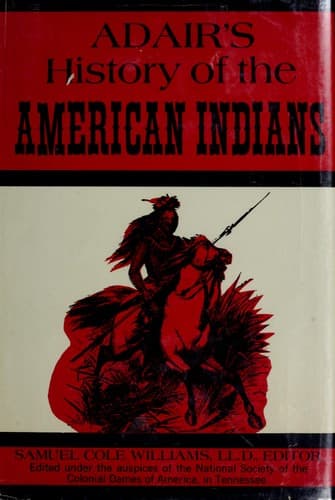
Adair's History of the American IndiansAdair, James
History
Adair's History of the American Indians
Adair, James
Indians -- Origin; Indians of North America -- Southern States
The method of counting time by weeks, or sevenths, was a very ancient
custom, practised by the Syrians, Egyptians, and most of the oriental
nations; {75} and it evidently is a remain of the tradition of the
creation. The Creator, indeed, renewed to the Hebrews the old precept of
sanctifying the seventh day, on a particular occasion. And Christianity
promoted that religious observance in the western world, in remembrance
of the work of redemption. The Greeks counted time by decads, or tens;
and the Romans by nones, or ninths. The number, and regular periods of
the Indians public religious feasts, of which presently, is a good
historical proof, that they counted time by, and observed a weekly
sabbath, long after their arrival on the American continent.
They count the day also by the three sensible differences of the sun,
like the Hebrews—sun-rise, they term, _Hassé kootcha meente_, “the sun’s
coming out;”—noon, or mid-day, _Tabookòre_;—and sun-set, _Hassé Oobèa_,
literally, “the sun is dead;” likewise, _Hasse Ookka’tòra_, that is,
“the sun is fallen into the water;” the last word is compounded of
_Ookka_, water, and _Etòra_, to fall: it signifies also “to swim,” as
instinct would direct those to do, who fell into the water. And they
call dark, _Ookklille_—derived from _Ookka_, water, and _Illeh_, dead;
which shews their opinion of the sun’s disappearance, according to the
ancients, who said the sun slept every night in the western ocean. They
subdivide the day, by any of the aforesaid three standards—as half way
between the sun’s coming out of the water; and in like manner, by
midnight, or cock-crowing, &c.
They begin the year,[29] at the first appearance of the first new moon
of the vernal æquinox, according to the ecclesiastical year of Moses:
and those synodical months, each consist of twenty-nine days, twelve
hours, and forty odd minutes; which make the moons, alternately, to
consist of twenty-nine and of thirty days. They pay a great regard to
the first appearance of every new moon, and, on the occasion, always
repeat some joyful sounds, and stretch out their hands towards her—but
at such times they offer no public sacrifice.
Public-domain text, read in full here on John Shaqi.
Reviews
Reviews
No reviews yet
Be the first to share your thoughts on this work.
Elsewhere in the archive
Join the Discussion
Join the discussion
Sign in to leave a comment or review.
Sign InorCreate an account