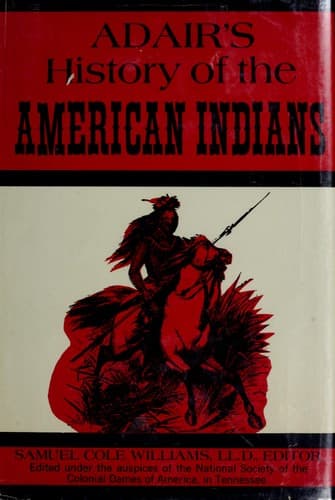
Adair's History of the American IndiansAdair, James
History
Adair's History of the American Indians
Adair, James
Indians -- Origin; Indians of North America -- Southern States
The Cheerake call twenty, _Tahre Skoeh_, “two tens;” and the Chikkasah
term it, _Pokoole Toogalo_, “ten twos:” as if the former had learned to
number from the left hand to the right, according to the Syriac custom;
and the latter, from the right to the left hand, after the Hebrew
manner. The former call an hundred, _Skoeh Chooke_; and, as before
observed, a thousand, _Skoeh Chooke Kaiére_, or “the old one’s hundred;”
for with them, _Kaiére_ signifies “ancient,” or aged; whereas _Eti_, or
_Eti-u_, expresses former old time. {78} May not this have some
explanation, by the “Ancient of days,” as expressed by the prophet
Daniel—magnifying the number, by joining one of the names of God to
it—according to a frequent custom of the Hebrews? This seems to be
illustrated with sufficient clearness, by the numerical method of the
Chikkasah—for they call an hundred, _Pokoole Tathleepa_; and a thousand,
_Pokoole Tathleepa Tathleepa Ishto_; the last of which is a strong
double superlative, according to the usage of the Hebrews, by a
repetition of the principal word; or by affixing the name of God to the
end of it, to heighten the number. Ishto is one of their names of God,
expressive of majesty, or greatness; and _Soottathleepa_[XVIII], the
name of a drum, derived from _Sootte_, an earthen pot, and _Tathleepa_,
perhaps the name or number of some of their ancient legions.
Footnote XVIII:
The double vowels, _oo_ and _ee_, are always to be joined in one
syllable, and pronounced long.
The Muskohge method of counting is, _Hommai_ 1, _Hokkóle_ 2, _Tootchēna_
3, _Ohsta_ 4, _Chakàpe_ 5, _Eepáhge_ 6, _Hoolopháge_ 7, _Cheenèpa_ 8,
_Ohstàpe_ 9, _Pokóle_ 10, &c. I am sorry that I have not sufficient
skill in the Muskohge dialect, to make any useful observations on this
head; however, the reader can easily discern the parity of language,
between their numerical words, and those of the Chikkasah and Choktah
nations; and may from thence conclude, that they were formerly one
nation and people.
Public-domain text, read in full here on John Shaqi.
Reviews
Reviews
No reviews yet
Be the first to share your thoughts on this work.
Elsewhere in the archive
Join the Discussion
Join the discussion
Sign in to leave a comment or review.
Sign InorCreate an account