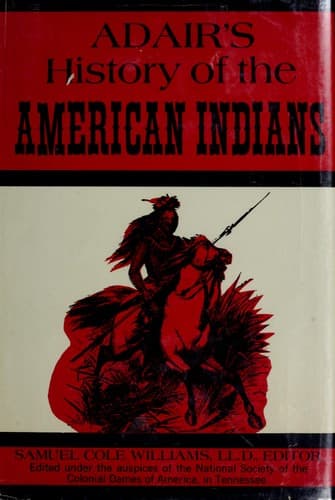
Adair's History of the American IndiansAdair, James
History
Adair's History of the American Indians
Adair, James
Indians -- Origin; Indians of North America -- Southern States
I have seen their symbols, or signatures, in a heraldry way, to count or
distinguish their tribes, done with what may be called wild exactness.
The Choktah use the like in the dormitories of their dead; which seems
to argue, that the ancienter and thicker-settled countries of Peru and
Mexico had formerly, at least, the use of hieroglyphic characters; and
that they painted the real, or figurative images of things, to convey
their ideas. The present American Aborigines seem to be as skilful
Pantomimi, as ever were those of ancient Greece or Rome, or the modern
Turkish mutes, who describe the meanest things spoken, by gesture,
action, and the passions of the face. Two far-distant Indian nations,
who understand not a word of each other’s language, will intelligibly
converse together, and contract engagements, without any interpreter, in
such a surprizing manner, as is scarcely credible. As their dialects are
guttural, the indications they use, with the hand or {79} fingers, in
common discourse, to accompany their speech, is the reason that
strangers imagine they make only a gaggling noise, like what we are told
of the Hottentots, without any articulate sound; whereas it is an
ancient custom of the eastern countries, which probably the first
emigrants brought with them to America, and still retain over the
far-extended continent[XIX].
Footnote XIX:
The first numbering was by their fingers; to which custom Solomon
alludes, _Prov._ iii. 16. “length of days is in her right hand.” The
Greeks called this, Αποπεμπομαζειv, because they numbered on their
five fingers: and Ovid says, _Seu, quia tot digitis, per quos numeráre
solemus_; likewise Juvenal, _Sua dextrâ computat annos_. Others
numbered on their ten fingers, as we may see in Bede de ratione
temporum. And the ancients not only counted, but are said to speak
with their fingers, _Prov._ vi. 13, “The wicked man he teacheth with
his fingers.” And Nævius, in Tarentilla, says, _dat digito literas_.
(A). Lord Kingsborough says the statement in the text is confirmed by
Francisco Vazquez de Coronado. (W).
ARGUMENT VII.
In conformity to, or after the manner of the Jews, the Indian Americans
have their PROPHETS, HIGH-PRIESTS,[31] and others of a religious order.
As the Jews had a _sanctum sanctorum_, or most holy place, so have all
the Indian nations; particularly, the Muskohge. It is partitioned off by
a mud-wall about breast-high, behind the white seat, which always stands
to the left hand of the red-painted war-seat; there they deposit their
consecrated vessels, and supposed holy utensils, none of the laity
daring to approach that sacred place, for fear of particular damage to
themselves, and general hurt to the people, from the supposed divinity
of the place.
Public-domain text, read in full here on John Shaqi.
Reviews
Reviews
No reviews yet
Be the first to share your thoughts on this work.
Elsewhere in the archive
Join the Discussion
Join the discussion
Sign in to leave a comment or review.
Sign InorCreate an account