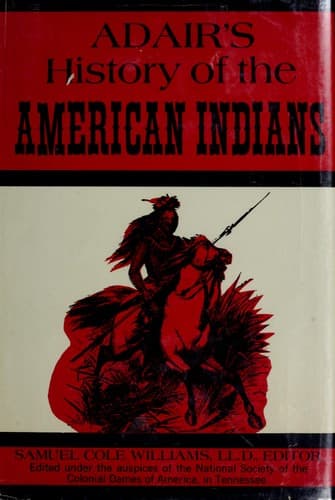
Adair's History of the American IndiansAdair, James
History
Adair's History of the American Indians
Adair, James
Indians -- Origin; Indians of North America -- Southern States
The Indians use the word _Hakse_, to convey the idea of a person’s
being criminal in any thing whatsoever. If they mention not the
particular crime, they add, _Kakset Kanehah_, pointing as it were to
those who were punished in Canaan. Such unfortunate persons as are
mad, deaf, dumb or blind, are called by no other name than _Hakse_. In
like manner _Kallakse_ signifies “contemptible, unsteady, light, or
easily thrown aside,”—it is a diminutive of קלל, of the same meaning.
And they say such an one is _Kallaks’-Ishto_, “execrated, or accursed
to God,” because found light in the divine balance. As the American
Aborigines used no weights, the parity of language here with the
Hebrew, seems to assure us, they originally derived this method of
expression from the Israelites, who took the same idea from the poise
of a balance, which divine writ frequently mentions. Job, chap. xxi,
describes justice with a pair of scales, “Let me be weighed in an even
balance, that I may know my perfection.” And they call weighing, or
giving a preference, _Tekále_, according to the same figure of speech:
and it agrees both in expression and meaning, with the Chaldean
_Tekel_, if written with Hebrew characters, as in that extraordinary
appearance on the wall of the Babylonish monarch, interpreted by the
prophet Daniel. When they prefer one person and would lessen another,
they say _Eeàpa Wéhke Tekále_, “this one weighs heavy,” and _Eeàko
Kallakse_, or _Kall’aks’ooshe Tekále_, “that one weighs light, very
light.” When any of their people are killed on any of the hunting
paths, they frequently say, _Heenna tungga Tannip Tekále_, “right on
the path, he was weighed for the enemy, or the opposite party,” for
_Tannip_ is the only word they have to express the words _enemy_ and
the _opposite_; as _Ook’heenna Tannip_, “the opposite side of the
water path:” hence it is probable, they borrowed that notable Assyrian
expression while in their supposed captivity, brought it with them to
America, and introduced it into their language, to commemorate so
surprising an event.
Like the present Jews, their old men are tenacious of their ancient
rites and customs; imagining them to be the sure channel through which
all temporal good things flow to them, and by which the opposite evils
are averted. No wonder therefore, that they still retain a multiplicity
of Hebrew words, which were repeated often with great reverence in the
temple; and adhere to many of their ancient rules and methods of
punishment. {157}
ARGUMENT XV.
Public-domain text, read in full here on John Shaqi.
Reviews
Reviews
No reviews yet
Be the first to share your thoughts on this work.
Elsewhere in the archive
Join the Discussion
Join the discussion
Sign in to leave a comment or review.
Sign InorCreate an account