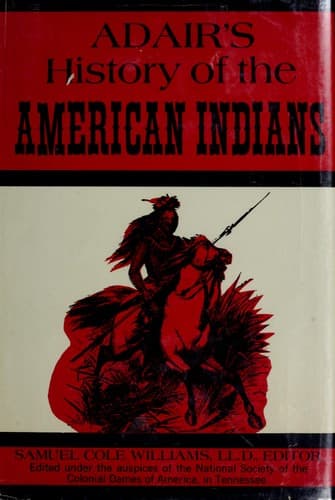
Adair's History of the American IndiansAdair, James
History
Adair's History of the American Indians
Adair, James
Indians -- Origin; Indians of North America -- Southern States
_Loak_ signifies fire, and _Loak Ishtohoollo_, “the holy or divine
fire,” or the anger of Ishtohoollo, “the great, holy One;” which nearly
agrees with the Hebrew להט, that which flames, or scorches with vehement
heat. And it is the scripture method of conveying to us a sensible idea
of the divine wrath, according to the cherubic name אש, which likewise
signifies fire. But the Persians worshipped the burning fire, by the
name of _Oromazes_; and darkness, or the spirit, by that of _Aramanius_;
quite contrary to the religious system of the Indian Americans: and the
aforesaid Indian method of expression, seems exactly to coincide with
the Hebrew idiom.
_Buk-she-ah-ma_ is the name of their Indian flap, or broad slip of cloth
with which the men cover their nakedness; but the word they use to
express our sort of breeches, is a compound, _Bala-phooka_, derived from
the Hebrew באל, which signifies, behind; and the Indian _Naphooka_, a
coat, any kind of clothes, or covering; _Baloka_ signifies, behind;
silently telling us, they formerly wore a different sort of breeches to
what they use at present. They likewise say, _Neeppe-Phú-ka_, “A
flesh-covering.”
The father of King Saul was called Kish, “podex;” which signifies also
the rear of an army, or the hindermost person, according to the Hebrew
idiom. Thus the Indians, by _Kish_, express the podex of any animal—the
hindermost person—the gavel-end of an house, and the like. _Kish Kish_,
is with them a superlative, and, as before hinted, used to convey the
contempt they have for that proper name. May not the contemptible idea
the West-Florida-Missisippi Indians affix to the name of Kish, be on
account of his son’s succession to the throne, at the end of the
theocracy of Israel, and beginning a despotic regal government?
The Indians, according to the usage of the Hebrews, always prefix the
substantive to the adjective; as _Netak Chookòma_, “A good day;”
_Nakkàne_ and _Eho Chookòma_, “A goodly man and woman.” The former of
which is termed, in Hebrew, _Yoma Tobe_, signifying, according to our
method of salutation, a good-day, a merry season, a festival day, &c.
And the Indian appellatives are similarly exprest in Hebrew, _Behtobe_
and _Ashe-Tobe_, “A good, goodly, discreet, or wise man and woman.”
_Chookoma_, with the Indians, is the proper name of a comely woman, when
_A_ is prefixed to it; as _A-chookòma_, “My goodly, or beautiful:” they
use it for a warrior, {44} when it is compounded without the _A_; as
_Chookòma hummáshtàbe_, “One who killed a beautiful, great, red, or
war-chieftain;” which is compounded of _Chookoma_, comely, _Humma_, red,
אש, _Ash_, fire, and _Abe_, a contraction of אבל, _Abele_, signifying
grief, or sorrow. Hence it appears, that because the Hebrews affixed a
virtuous idea to _Tobe_, goodly; the Indians call white by the same
name, and make it the constant emblem of every thing that is good,
according to a similar Hebrew custom. Of this the sacred oracles make
frequent mention.
Public-domain text, read in full here on John Shaqi.
Reviews
Reviews
No reviews yet
Be the first to share your thoughts on this work.
Elsewhere in the archive
Join the Discussion
Join the discussion
Sign in to leave a comment or review.
Sign InorCreate an account