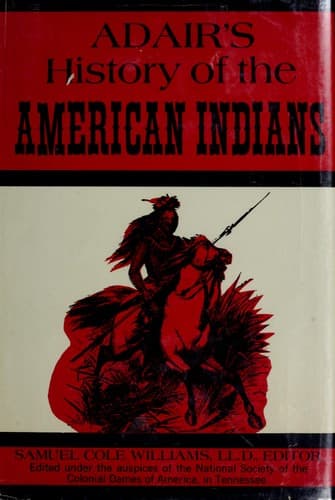
Adair's History of the American IndiansAdair, James
History
Adair's History of the American Indians
Adair, James
Indians -- Origin; Indians of North America -- Southern States
The Jews called that, which was the most excellent of every thing, the
_fat_; and the Indians, in like manner, say, _Oosto Neehe_, “The fat of
the pompion,” _Tranche Neehe_, “The fat of the corn.” _Neeha_ is the
adjective, signifying _fat_, from which the word _Neeta_, “a bear,” is
derived. They apply the word _heart_, only to animate beings.
As the Deity is the soul of every system—and as every nation, from the
remotest ages of antiquity, believed that they could not live well,
without some god or other; when, therefore, we clearly understand the
name, or names, by which any society of people express their notions of
a deity, we can with more precision form ideas of the nature of their
religious worship, and of the object, or objects, of their adoration. I
shall therefore here give a plain description of the names by which the
Indian Americans speak of God.
_Ishtohoollo_ is an appellative for God. Ishtohoollo points at the
greatness, purity, and goodness, of the Creator in forming איש and אישא:
it is derived from _Ishto_, GREAT, which was the usual name of God
through all the prophetic writings; likewise, from the present tense of
the infinitive mood of the active verb, _Ahoollo_, “I love,” and from
the preter tense of the passive verb, _Hoollo_, which signifies
“sanctifying, sanctified, divine, or holy.” Women set apart, they term,
_Hoollo_, _i. e._ sanctifying themselves to Ishtohoollo: likewise,
_Netakhoollo_ signifies “a sanctified, divine, or holy day;” and, in
like manner, _Ookka Hoollo_, “water sanctified,” &c. So that,
_Ishtohoollo_, when applied to God, in its true radical meaning,
imports, “The great, beloved, holy Cause;” which is exceedingly
comprehensive, and more expressive of the true nature of God, than the
Hebrew name _Adonai_, which is applicable to a human being. Whenever the
{45} Indians apply the epithet, compounded, to any of their own
religious men, it signifies the great, holy, beloved, and sanctified men
of the Holy One.
They make this divine name point yet more strongly to the supreme author
of nature; for, as אב, signifies father; and as the omnipresent Spirit
of the universe, or the holy father of mankind, is said to dwell above,
they therefore call the immense space of the heavens, _Aba_, _Abáse_,
and _Abatàra_: and, to distinguish the King of kings, by his attributes,
from their own _Minggo Ishto_, or great chieftains, they frequently name
him _Minggo Ishto Aba_, &c.; _Ishto Aba_, &c.; _Minggo Aba_, &c.; and,
when they are striving to move the passions of the audience,
_Ishtohoollo Aba_. The Hebrew servants were not allowed to call their
master or mistress אב, _Abba_, till they were adopted: to which custom
St. Paul alludes, _Rom._ viii. 15.
Public-domain text, read in full here on John Shaqi.
Reviews
Reviews
No reviews yet
Be the first to share your thoughts on this work.
Elsewhere in the archive
Join the Discussion
Join the discussion
Sign in to leave a comment or review.
Sign InorCreate an account