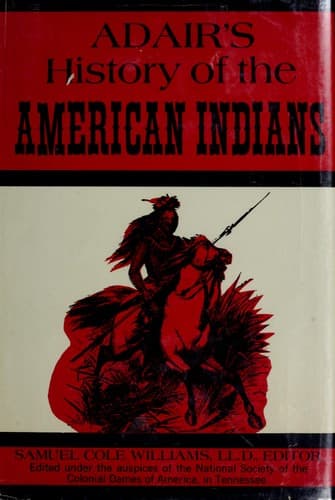
Adair's History of the American IndiansAdair, James
History
Adair's History of the American Indians
Adair, James
Indians -- Origin; Indians of North America -- Southern States
O-E-A—YAH.
Footnote XII:
The strong sentiments, natural wit, and intense love of liberty, which
the Indians shew themselves possessed of, in a high degree, should
direct our colonists to pursue a different method of contracting
Indian covenants than they have commonly used. First, let them
consider the general good of the community, who chose them for that
end; and then make a plain agreement with the Indians, adapted to
their fixed notion of liberty, and the good of their country, without
any deluding sophisms. If they do not keep these essential points of
amity in view, we shall fare again, as hath Georgia; for, by a
childish treaty with the Muskohge Indians, when defeated An. 1715, its
most northern boundaries are confined to the head of the ebbing and
flowing of Savannah river. We are said to have flourished off very
commodious Indian treaties in the _council-books_, with the Muskohge,
which the community know nothing of, except a few plain common
particulars, as they some years since declared.
The Chikkasah and Choktah method of adjuring a witness to give true
evidence, is something similar to the former attestation, by _To e u
hah_: when they ask them, whether they do not lie, they adjure them
thus, _Chiklooska ke-e-u Chua?_ The termination implies a question of
the second person, singular number, and the whole oath signifies
literally, “Do not you lie? Do you not, of a certain truth?” To which he
answers by two strong negative asseverations, _Aklooska Ke-e-u-que-Ho_,
“I do not lie; I do not, of a certain truth.” When the Choktah are
averring any thing asked of them, they assert it, by saying YAH. This
shews their ignorance of the vowels of the supposed divine four-lettered
name, in comparison of the Cheerake; and that they are become less
religious, by prophaning the divine name, YAH; which confirms me in the
opinion, that the Cheerake Indians were a more civilized people than any
of the other neighbouring Indians.
We are told that the northern Indians, in the time of their rejoicings,
repeat YO HA HAN; which, if true, evinces that their corruption
advances, in proportion as they are distant from South-America, and
wanted a {51} friendly intercourse with those who had an open
communication with those southern regions[XIII]. Living in moderate high
latitudes, would naturally prevent them from sinking into effeminacy,
and inspire them with martial tempers, (as we are told of the Chili
Indians) without being originally a bloodier people than any of the
southern nations. However, we should be sparing of credit to what
unskilful writers have carefully copied from each other, and transmitted
to the learned world.
Footnote XIII:
Public-domain text, read in full here on John Shaqi.
Reviews
Reviews
No reviews yet
Be the first to share your thoughts on this work.
Elsewhere in the archive
Join the Discussion
Join the discussion
Sign in to leave a comment or review.
Sign InorCreate an account