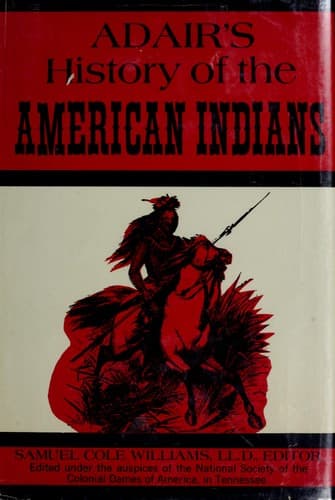
Adair's History of the American IndiansAdair, James
History
Adair's History of the American Indians
Adair, James
Indians -- Origin; Indians of North America -- Southern States
The greater number of their compounded words, (and, I believe, every one
of them) which convey a virtuous or pure idea, either have some
syllables of the three divine names, or visibly glance at them; or have
one or two vowels of the sacred name, YO HE WAH, and generally begin
with one of them; which I shall exemplify, with a few Chikkasah and
Cheerake words. _Isse-Ahowwè_, “Deer;” _Yanàsa_, Buffalo, which as it
begins with the divine name, YAH, contains no more of their beloved
vowels: in like manner, _Wahka_, “cattle;” _Ishke-Oochēa_, “a mother.”
This last seems to be drawn from _Isha_, the mother of all mankind.
_Ehó_ and _Enekia_ signify “a woman.” The latter is derived from the
active verb, _Akekiuhah_, signifying “to love ardently,” or like a
woman; _Nakkàne Askai_, “a man.” From this word, the Chikkasah derive
_Nakke_, the name of an arrow or bullet: and with the Cheerake _Askai_
signifies “to fear;” as all the American brute animals were afraid of
man, &c.
Words, which imply either a vicious or impure idea, generally begin with
a consonant, and double those favourite vowels, either at the beginning
and end, or in the middle, of such words; as _Nassooba Woheea_, “a
wolf.” With the Chikkasah, _Eassooba_ signifies “bewildered;” _Patche_,
“a pigeon,” and _Patche Eassooba_, “a turtle-dove.” _Soore_ and _Sheeke_
are the Chikkasah and Cheerake names of a “Turkey-buzzard;” _Choola_ and
_Choochòla_, “a fox;” _Shookqua_ and _Seequa_, an “opossum,” or hog;
_Ookoonne_, “a polecat;” _Ookoonna_, “a badger;” _Chookphe_ and
_Cheesto_, “a rabbet.” The last word is derived from the defective verb
_Chesti_, “forbear,” or do not meddle with; and rabbets were prohibited
to the Israelites. In like manner, _Ooppa_ and _Ookookoo_, “a
night-owl;” _Oophe_ and _Keera_, “a dog;” _Nahoolla_ and _U-nēhka_,
“white people,” or “impure animals.” The Chikkasah both corrupt and
transpose the last part of the divine name, Ishtohoollo; and the
Cheerake invert their magnifying termination _U_, to convey an impure
idea. And through the like faint allusion to this divine name, _Hoollo_
signifies “idols, pictures, or images;” a sharp-pointed sarcasm! for the
word, _Hoollo_, signifies also “menstruous women,” who were for the time
an equal abomination to the Israelites, and with whom they were to have
no communion. These two words seem to bear the same analogy to each
other, as אל, _Al_, a name of God, and אלה, _Aleh_, signifying the
covenant of the holy One to redeem man, and אלוה, _Aloah_, execrated, or
accursed of God, as idols were. {57}
Public-domain text, read in full here on John Shaqi.
Reviews
Reviews
No reviews yet
Be the first to share your thoughts on this work.
Elsewhere in the archive
Join the Discussion
Join the discussion
Sign in to leave a comment or review.
Sign InorCreate an account