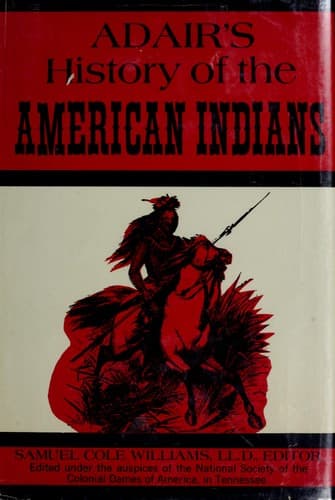
Adair's History of the American IndiansAdair, James
History
Adair's History of the American Indians
Adair, James
Indians -- Origin; Indians of North America -- Southern States
With the Cheerake, _Awwa_, or _Amma_, signifies “water,” and _Ammoi_, “a
river;” not much unlike the Hebrew. They likewise term salt, _Hawa_; and
both the conjunction copulative, and “to marry,” is _Tawa_. The name of
a wife is _Awah_; which written in Hebrew, makes הוה, _Eve_, or _Eweh_,
the name of our general mother. So that the Indian name of a wife, is
literally and emphatically, HIS AND, “One absolutely needful for the
well-being of _Ish_, or man;” _Ishtawa (tim?)_ signifies “have you
married?” We gain additional light from the strong significant
appellative, _Ish-ke_, “a mother;” which is an evident contraction of
_Isha_, the mother of _Yawe_, or mankind, with their favourite
termination, _ske_, subjoined; the word becomes thus smoother than to
pronounce it at its full length, _Isha-ske_. If we consider that the
Hebrews pronounced ו, _Vau_, when a consonant, as _W_, here is a very
strong, expressive gradation, through those various words, up to the
divine, necessary, AND, who formed and connected every system of beings;
or to the Hebrew divine original YO HE WAH: at the same time, we gain a
probable reason why so many proper names of old Indian places, in
South-Carolina, and elsewhere, along the great continent, begin with our
Anglo-Saxon borrowed character, _W_; as _Wampee_, _Watboo_, _Wappoo_,
_Wadmolā_, _Wassamèsāh_, &c. Chance is fluctuating, and can never act
uniformly.
To elucidate the aforesaid remarks, it may not be amiss to observe,
that, according to the Israelitish custom both of mourning, and
employing mourners for their dead, and calling weeping, the lifting up
of their voices to God, the Choktah literally observe the same custom;
and both they and the Chikkasah term a person, who through a pretended
religious principle bewails the dead, _Yah-ah_, “Ah God!” and one, who
weeps on other occasions, _Yāhma_, “pouring out salt tears to, or before
God;” which is similar to יהמי. When a person weeps very bitterly, they
say, _Yahmishto_, which is a compounded word, derived from יה, and ומי,
with the initial part of the divine name, _Ishtohoollo_, subjoined, to
magnify the idea, according to the usage of the Hebrews. When the divine
penman is describing the creation, and the strong purifying wind, which
swept along the surface of the waters, he calls it, “the air, or
spirit;” and, more significantly, “the wind of God,” or a very great
wind: and, in other parts of the divine oracles, great hail, a {58}
great lion, and the like, are by the same figure, called the hail of
God. They also apply the former words, _Yah-ah_, _Yah-ma_, and the like,
to express the very same ideas through all the moods and tenses as
_Cheyaàras_, “I shall weep for you;” _Sawa Cheyaàra Awa_, “Wife, I will
not weep for you.” And when the violence of their grief for the
deceased, is much abated, the women frequently, in their plaintive
notes, repeat _Yo Hé (tà) Wāh, Yo Hé (tà) Weh, Yò Hé ta Há, Yo Hê tà
Public-domain text, read in full here on John Shaqi.
Reviews
Reviews
No reviews yet
Be the first to share your thoughts on this work.
Elsewhere in the archive
Join the Discussion
Join the discussion
Sign in to leave a comment or review.
Sign InorCreate an account