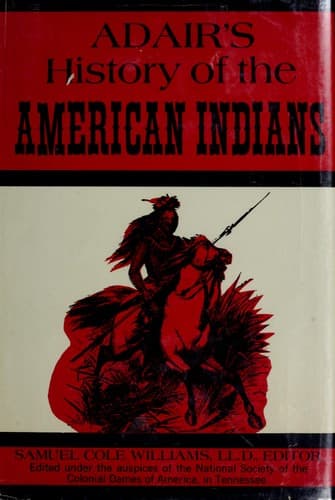
Adair's History of the American IndiansAdair, James
History
Adair's History of the American Indians
Adair, James
Indians -- Origin; Indians of North America -- Southern States
Héh_; with a reference probably to the Hebrew custom of immoderately
weeping and wailing for their dead, and invoking the name of God on such
doleful occasions; and which may have induced these supposed red Hebrews
to believe the like conduct, a very essential part of religious duty.
_Neetak Yah-ah_ signifies “a fast day,” because they were then humbly to
say _Ah_, and afflict their souls before YAH. In like manner, _Yah Abe_
signifies “one who weeps for having killed, or murdered another.” Its
roots are יה, _Yah_, their continual war-period, and, אבל, _Abele_,
signifying “sorrow or mourning;” for, as killing, or murdering, is an
hostile act, it cannot be drawn from אבה, which signifies brotherly
love, or tender affection. _Nana-Yah-Abe_ describes a person weeping,
while another is killing him. Now, as _Nana_ is “a relation,” _Yah_
“God,” and _Abe_ as above, the true meaning seems to be, “One, like
bleeding Abele, weeping to God.” Likewise their name for salt, _Hawa_,
may inform us, that though at present they use no salt in their
religious offerings, they forbore it, by reason of their distant
situation from the sea-shore, as well as by the danger of blood
attending the bringing it through an enemy’s country; for, according to
the idiom of their language, if they had not thought salt an essential
part of the law of sacrificature, they most probably, would not have
derived it from the two last syllables of the great divine name; whereas
they double the consonant, when they express water, without drawing it
from the clear fountain of living waters, YO HE WAH.
With the Hebrews, as before observed[XIV], טפל, _Tephale_, signifies
“shaking or pulling of the hand, cohesion, conjunction, or entering into
society;” and “praying, or invoking.” In conformity to that original
standard, when the Indians would express a strong, lasting friendship,
they have no {59} other way, than by saying, _Aharattlè-la pheena
chemanumbóle_, “I shall firmly shake hands with your discourse, or
speech.”
Footnote XIV:
Page 42.
Public-domain text, read in full here on John Shaqi.
Reviews
Reviews
No reviews yet
Be the first to share your thoughts on this work.
Elsewhere in the archive
Join the Discussion
Join the discussion
Sign in to leave a comment or review.
Sign InorCreate an account