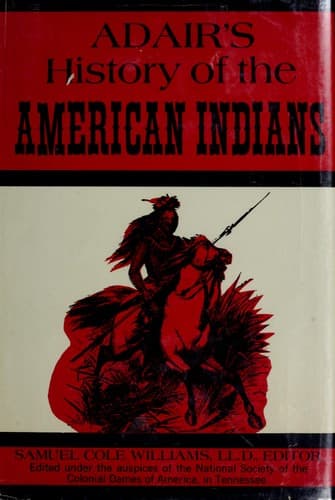
Adair's History of the American IndiansAdair, James
History
Adair's History of the American Indians
Adair, James
Indians -- Origin; Indians of North America -- Southern States
When two nations of Indians are making, or renewing peace with each
other, the ceremonies and solemnities they use, carry the face of great
antiquity, and are very striking to a curious spectator, which I shall
here relate, so far as it suits the present subject. When strangers of
note arrive near the place, where they design to contract new
friendship, or confirm their old amity, they send a messenger a-head, to
inform the people of their amicable intention. He carries a swan’s wing
in his hand, painted all over with streaks of white clay, as an
expressive emblem of their embassy. The next day, when they have made
their friendly parade, with firing off their guns and whooping, and have
entered the beloved square, their chieftain, who is a-head of the rest,
is met by one of the old beloved men, or magi, of the place. He and the
visitant approach one another, in a bowing posture. The former says,
_Yò, Ish la chu Anggòna?_ “Are you come a friend in the name of God?”
Or, “Is God with you, friend?” for, _Yo_ is a religious contraction of
_Yohewah_,—_Ish_ “the man,” _La_ a note of joy, _Chu_ a query, and
_Anggona_ “a friend.” The other replies, _Yah—Arahre-O, Anggona_, “God
is with me, I am come, a friend, in God’s name.” The reply confirms the
meaning of the questionary salute, in the manner before explained. The
magus then grasps the stranger with both his hands, around the wrist of
his right hand, which holds some green branches—again, about the
elbow—then around the arm, close to his shoulder, as a near approach to
the heart. Then his immediately waving the eagles tails over the head of
the stranger, is the strongest pledge of good faith. Similar to the
Hebrew word, _Phále_ with the Indians, signifies “to wave,” and likewise
to shake; for they say, _Skooba—Phále_, “shaking one’s head.” How far
the Indian oath, or manner of covenanting, agrees with that of the
Hebrews, on the like solemn occasion, I refer to the intelligent reader.
Their method of embracing each other, seems to resemble also that custom
of the Hebrews, when a stranger became surety for another, by giving him
his wrist; to which Solomon alludes, “If thou hast stricken hand with
the stranger, &c.”—Their common method of greeting each other, is
analogous with the above; the host only says, _Ish-la Chu?_ and the
guest replies, _Arahre-O_, “I am come in the name of O E A,” or YO HE
WAH. {60}
When _O_ is joined to the end of words, it always denotes a superlative,
according to their universal figurative abbreviations of the great
beloved name; thus with the Chikkasah, _Isse_, “deer,” and _Isse-O_,
“very great deer;” _Yanása_, “a buffalo,” _Yanas-O_, “a very
extraordinary great buffalo;” which is, at least, as strong a
superlative, as אל ביח אל, signifying “the house of the Omnipotent,” or
“the temple.”
Public-domain text, read in full here on John Shaqi.
Reviews
Reviews
No reviews yet
Be the first to share your thoughts on this work.
Elsewhere in the archive
Join the Discussion
Join the discussion
Sign in to leave a comment or review.
Sign InorCreate an account