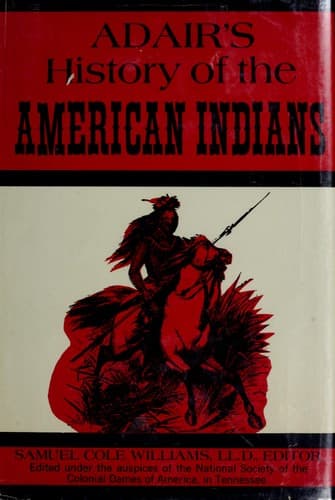
Adair's History of the American IndiansAdair, James
History
Adair's History of the American Indians
Adair, James
Indians -- Origin; Indians of North America -- Southern States
Clay basons they call _Ai-am-bo_, and their old round earthen forts,
_Aiambo Cháah_, this last word signifying “high,” or tall: but a
stockade, or wooden fort, they term, _Hoorèta_, and to inswamp,
_Book-Hoore_, from _Bookse_, “a swamp,” and _Hoorèta_, “a fort, or place
of difficult access.” High waters, conveys to them, an idea only of
deepness; as _Ookka phobe_, “deep waters.” And they say, _Ookka chookòma
intáa_, “The water glides, or moves along pleasantly, or goodly.” That
the word _Intâa_, has _Ya-ah_ for its radix, is apparent from their name
for a rapid current, _Yahnāle_, “it runs with a very extraordinary
force;” the mid consonant is placed there, to give the word a suitable
vehemence of expression—and the word is compounded of יה, _Yah_, and אל,
_Ale_, two names of God. In like manner, _Yahnhà_ signifies “a
pleurisy,” fever, and the like; because they reckon, when YAH says _ha_
in anger, to any of their vicious people, he immediately fires the
blood, and makes it run violently through all the veins of the body.
_Ashtahále_ signifies the reflection of the celestial luminaries, which
is composed of two of the divine names; as אש, _Ash_, the celestial,
cherubimical name of God, signifying fire, _ta_, a contraction of the
conjunction copulative, and אל, _Ale_, the strong, or omnipotent. They
say a river, or warm victuals, is _A-shu-pa_; that is, the former is
become fordable, and the latter eatable. They here divide _Ash_ into two
syllables; and the termination alludes to the word, _Apà_, which
signifies eating. {67}
Public-domain text, read in full here on John Shaqi.
Reviews
Reviews
No reviews yet
Be the first to share your thoughts on this work.
Elsewhere in the archive
Join the Discussion
Join the discussion
Sign in to leave a comment or review.
Sign InorCreate an account