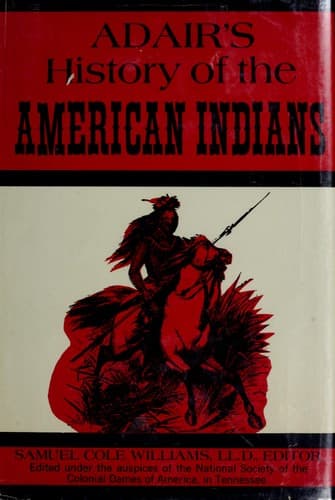
Adair's History of the American IndiansAdair, James
History
Adair's History of the American Indians
Adair, James
Indians -- Origin; Indians of North America -- Southern States
The Indian compounded words, are generally pretty long; but those that
are radical, or simple, are mostly short: very few, if any of them,
exceed three or four syllables. And, as their dialects are guttural,
every word contains some consonants; and these are the essential
characteristics of language. Where they deviate from this rule, it is by
religious emblems; which obviously proceeds from the great regard they
paid to the names of the Deity; especially, to the four-lettered,
divine, essential name, by using the letters it contains, and the vowels
it was originally pronounced with, to convey a virtuous idea; or, by
doubling, or transposing them, to signify the contrary. In this they all
agree. And, as this general custom must proceed from one primary cause,
it seems to assure us, they were not in a {68} savage state, when they
first separated, and variegated their dialects, with so much religious
care, and exact art. Blind chance could not direct so great a number of
remote and warring savage nations to fix on, and unite in so nice a
religious standard of speech. Vowels are inexpressive of things, they
only typify them; as _Oo-E-A_, “to ascend, or remove:”—_O E A_, a most
sacred affirmation of the truth. Similar to these are many words,
containing only one consonant: as _To-e-u_, “it is very true;” _O-se-u_,
“very good;” _Y-O-U_, “evil, or very bad;” _Y-â-a_, “he moves by the
divine bounty;” _Nan-ne Y-a_, “the divine hill, or the mount of God,”
&c. If language was not originally a divine gift, which some of our very
curious modern philosophers deny, and have taken great pains to set
aside; yet human beings are possessed of the faculties of thinking and
speaking, and, in proportion to their ideas, they easily invented, and
learned words mixed with consonants and vowels, to express them. Natural
laws are common and general. The situation of the Indian Americans, has
probably been the means of sinking them into that state of barbarism we
now behold—Yet, though in great measure they may have lost their
primitive language, not one of them expresses himself by the natural
cries of brute-animals, any farther than to describe some of the animals
by the cries they make; which we ourselves sometimes imitate, as
_Choo-qua-lê-qua-lôô_, the name they give that merry night-singing bird,
which we call “Whip her will my poor wife,” (much like our cuckoo) so
termed from its musical monotony. No language is exempt from the like
simple copyings. The nervous, polite, and copious Greek tongue had the
loud-sounding _Böô Böao_, which the Romans imitated, by their bellowing
_Boves Böum_; and the Indians say _Pa-a_, signifying the loud noise of
every kind of animals, and their own loud-sounding war _Whoô Whoóp_.
Where they do not use divine emblems, their words have much articulation
of consonants. Their radicals have not the inseparable property of three
consonants, though frequently they have; and their words are not so
Public-domain text, read in full here on John Shaqi.
Reviews
Reviews
No reviews yet
Be the first to share your thoughts on this work.
Elsewhere in the archive
Join the Discussion
Join the discussion
Sign in to leave a comment or review.
Sign InorCreate an account