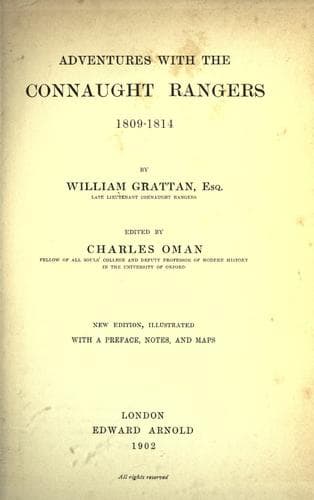
Adventures with the Connaught Rangers, 1809-1814 — John Shaqi
Adventures with the Connaught Rangers, 1809-1814Grattan, William
History
Adventures with the Connaught Rangers, 1809-1814
Grattan, William
Great Britain. Army. Regiment of Foot, 88th (Connaught Rangers); Peninsular War, 1807-1814 -- Personal narratives
Among these is the present volume—the reminiscences of a subaltern of
the Connaught Rangers, the old 88th. William Grattan was one of the
well-known Dublin family of that name—a first-cousin of Thomas Colley
Grattan the novelist, and a distant kinsman of Henry Grattan the
statesman; he joined the regiment as ensign on July 6, 1809. He went out
to the 1st Battalion, and reached it on the Caya late in 1809; he served
with it till the spring of 1813, when he went home on leave, having
obtained his lieutenancy on April 12, 1812. Thus he was for more than
four years continuously with the colours, and saw Busaco, Fuentes
d’Oñoro, El Bodon, the storms of Ciudad Rodrigo and Badajoz, Salamanca,
and the disastrous retreat from Burgos. He was only off duty for a few
weeks in 1812, in consequence of a wound received at Badajoz. In the
ranks of the 3rd Division—the “Fighting Division” as he is proud to call
it—he saw a greater portion of the war than most of his contemporaries,
though he missed Vittoria and the invasion of France which followed.
Grattan as an author had two great merits. He had a very considerable
talent for describing battles--indeed some of his chapters would not
have disgraced the pen of William Napier. Of the many memoirs which I
have read, I think that his is on the whole the most graphic and
picturesque in giving the details of actual conflict. His accounts of
Fuentes D’Oñoro, Salamanca, and above all of the storm and sack of
Ciudad Rodrigo and Badajoz, are admirable. The reader will find in them
precisely the touches that make the picture live. His second virtue is a
lively sense of humour. The Connaught Rangers were the most Irish of all
Irish regiments, and the “boys that took the world _aisy_,” as Grattan
calls them, were as strange a set to manage as ever tried an officer’s
temper. “I cannot bring myself to think them, as many did, a parcel of
devils,” writes Grattan; “neither will I by any manner of means try to
pass them off for so many saints” (pp. 128–129); but whether good or
bad, they were always amusing. For the exploits of Ody Brophy and Dan
Carsons, of Darby Rooney and Barney Mackguekin, I must refer the reader
to the book itself. Their doings, as recorded by the much-tried
commander of their company, explain clearly enough Sir Thomas Picton’s
addiction to drum-head court-martials, and Lord Wellington’s occasional
bursts of plain and drastic language.[1] But no one with any sense of
the ludicrous can profess any very lasting feeling of indignation
against these merry if unscrupulous rascals.
-----
Footnote 1:
See, for example, his remarks on the 88th to Sir James M’Grigor, on
page 259 of the latter’s autobiography.
-----
Public-domain text, read in full here on John Shaqi.
Reviews
Reviews
No reviews yet
Be the first to share your thoughts on this work.
Join the Discussion
Join the discussion
Sign in to leave a comment or review.
Sign InorCreate an account