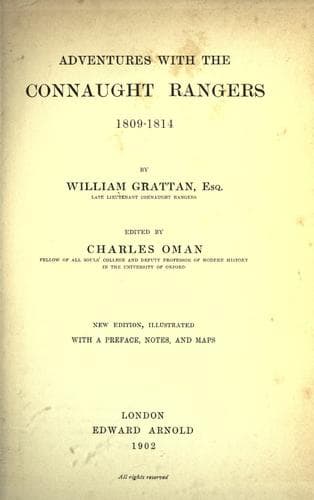
Adventures with the Connaught Rangers, 1809-1814 — John Shaqi
Adventures with the Connaught Rangers, 1809-1814Grattan, William
History
Adventures with the Connaught Rangers, 1809-1814
Grattan, William
Great Britain. Army. Regiment of Foot, 88th (Connaught Rangers); Peninsular War, 1807-1814 -- Personal narratives
It is clearly from the domestic annals of the 88th that Charles Lever
drew the greater part of the good stories which made the fortune of
_Charles O’Malley_. The reader will find many of the characters of that
excellent romance appearing as actual historical personages in Grattan,
notably the eccentric surgeon Maurice Quill, whose fame was so great
throughout the British army that the novelist did not even take the
trouble to change his name. His colleague Dr. O’Reily was almost as
great an original. Many of the humours of Mickey Free seem to be drawn
directly from the doings of Grattan’s servant Dan Carsons. Comparing the
“real thing” with the work of fiction, one is driven to conclude that
much of what was regarded as rollicking invention on Lever’s part, was
only a photographic reproduction of anecdotes that he had heard from old
soldiers of the Connaught Rangers.
Military diaries are often disappointing from one of two causes. Either
the author slips into second-hand and second-rate narratives of parts of
the campaign which he did not himself witness—things which he had better
have left to the professed historian—or he fails to give us those small
traits of the daily life of the regiment which are needed to make us
realise the actualities of war. Grattan sometimes falls into the
first-named fault, but never into the latter. He seems to have had an
instinctive knowledge of what future generations would want to know
concerning the old Peninsular army—its trials in the matter of pay,
food, and clothing, its shifts and devices, its views of life and death.
If any one wishes to know why Sir Thomas Picton was unpopular, or what
the private and the subaltern thought about Lord Wellington, they will
find what they seek in these pages. Nowhere else have I seen the
psychology of the stormers of Ciudad Rodrigo and Badajoz dealt with in
such a convincing fashion; let the reader note in particular pages 144–5
and 193–4.
I have to confess that in various parts of this reprint I have used the
Editor’s license to delete a certain amount of the author’s original
manuscript. Grattan had two besetting sins considered as a literary man.
The first was one to which I have already made allusion. Not
unfrequently he quitted his autobiographical narrative, and inserted
long paragraphs concerning parts of the war of which he had no personal
knowledge, _e.g._ about the movements of Hill’s corps in Estremadura, or
of the Spaniards in remote corners of the Peninsula. These, as is
natural, are often full of inaccuracies: sometimes (and this is a worse
fault) they turn out to be taken almost _verbatim_ from formal
histories, such as those of Colonel Jones and Lord Londonderry. In one
place I found thirty lines which were practically identical with a
passage in Napier. In all cases these relate to parts of the war which
did not come under Grattan’s own eyes: I have therefore ventured to omit
them.
Public-domain text, read in full here on John Shaqi.
Reviews
Reviews
No reviews yet
Be the first to share your thoughts on this work.
Join the Discussion
Join the discussion
Sign in to leave a comment or review.
Sign InorCreate an account