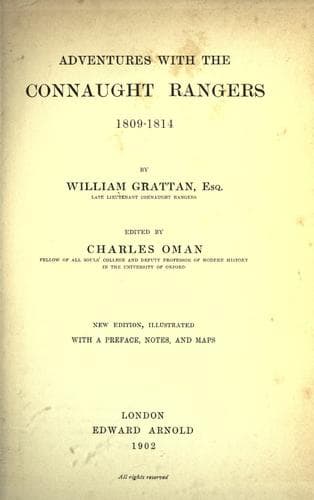
Adventures with the Connaught Rangers, 1809-1814Grattan, William
History
Adventures with the Connaught Rangers, 1809-1814
Grattan, William
Great Britain. Army. Regiment of Foot, 88th (Connaught Rangers); Peninsular War, 1807-1814 -- Personal narratives
He then held up the old goat by the beard, and shook it at Captain
Tyler, the General’s aide-de-camp, and taking it for granted that he had
made a peace-offering to the General, or, probably, not caring one straw
whether he had or not, went away with his burden, and was soon lost
sight of amongst a grove of chestnut-trees.
“Well,” said Picton, turning to Tyler, who was nearly convulsed with
laughter, “that fellow has some merit. What tact and what humour! He
would make a good outpost soldier, for he knows, not only how to forage,
but to take up a position that is unassailable.”
“Why yes, sir,” said Tyler, “when he held up the goat’s head, he seemed
to _beard_ us to our faces; and his promise of sending you a leg was a
capital ruse!”
“It was, faith,” replied Picton, “and if the fellow is found out, he
will, I suppose, endeavour to make _me_ the 'scape-goat'!”
The General used often to tell this story as one of the best things of
the sort he had ever met with.
It is a remarkable circumstance that a few days before the battle of
Waterloo, Picton met Wallace in London, when he spoke highly of the
regiment, and said if it returned from America in time to join the army
under the Duke of Wellington (being then on their passage home), and if
he joined the army, the 88th would be one of the first regiments he
would ask for his division.
CHAPTER III
Masséna’s invasion of Portugal—Fall of Ciudad Rodrigo and
Almeida—Craufurd’s fight on the Coa—Anecdote of Colonel Charles
Napier—The British retire to the position of Busaco.
In the month of January, 1810, Lord Wellington established his
headquarters at Viseu, in Upper Beira, and the different brigades of
cavalry and infantry were quartered in the neighbouring villages.
General Hill was left with five thousand British, and about as many
Portuguese, at Abrantes; and with his army posted as has been described,
the British General awaited the development of Masséna’s plan of
invasion. The amount of the French force at this period in the Peninsula
counted over three hundred and sixty thousand troops of all arms; but
the army commanded by Masséna, and called “the army of Portugal,” did
not amount to ninety thousand. The amount of the British and Portuguese
forces has been already stated to be about fifty-five thousand men; and
it will be recollected that of the Portuguese army scarcely one man in
one hundred had ever discharged a musket against an enemy. As to the
British, when Lord Wellington moved his army from the Guadiana its
numbers counted about thirty thousand, but those under arms scarcely
reckoned twenty thousand; the remainder were in hospital, and many of
those in the ranks were but ill able to carry their knapsacks and
firelocks, having not yet recovered from the effects of past illness.
Public-domain text, read in full here on John Shaqi.
Reviews
Reviews
No reviews yet
Be the first to share your thoughts on this work.
Join the Discussion
Join the discussion
Sign in to leave a comment or review.
Sign InorCreate an account