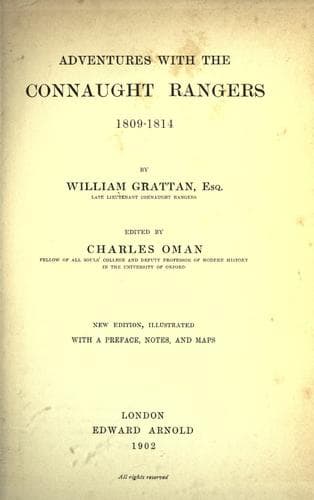
Adventures with the Connaught Rangers, 1809-1814Grattan, William
History
Adventures with the Connaught Rangers, 1809-1814
Grattan, William
Great Britain. Army. Regiment of Foot, 88th (Connaught Rangers); Peninsular War, 1807-1814 -- Personal narratives
The French preparations were so formidable, our own force so small, that
in the British ranks it was generally believed that the entire army
would retreat on Lisbon when the French advanced, and embark there. The
same was asserted in England; the Portuguese dreaded it; the French army
universally believed it, and the British ministers seem to have
entertained the same opinion; for at this time an officer of engineers
arrived at Lisbon, whose instructions, received personally from Lord
Liverpool, though unknown to Lord Wellington, commenced thus: “_As it is
probable that the army will embark in September._”
Fortunately for us, the French lingered long ere they began their
invasion. It was not till June 1810 that Ney began the siege of Ciudad
Rodrigo, while Masséna still remained at Madrid. The garrison of the
fortress amounted to about six thousand men, and was commanded by the
Spanish general, Herrasti, an old and gallant man who had served his
country with honour for more than half a century. The town was amply
supplied with artillery, provisions, and stores of all kinds; and the
vigorous resistance which was expected was made by Herrasti and his
brave garrison.
General Robert Craufurd, with his superb division, occupied the line of
the Coa, while General Cole, with the 4th Division, and Picton with the
3rd, were posted at Guarda and Pinhel; and these troops were directed to
be in readiness to render any support that could with safety be given to
the Spanish governor. That assistance could never be given, and Ciudad
Rodrigo fell, after sustaining a siege of upwards of a month. Its
gallant defence reflected great credit on both the governor and
garrison, and the delay it caused the French army was of the greatest
importance to Lord Wellington’s plan of resistance, because the heavy
rains which were almost sure to fall in the autumn would greatly aid in
the defence of the country.
After his capture of Rodrigo, Masséna lost no time in laying siege to
Almeida, and it was hoped that this town, which was, though by no means
a model of perfection, a more regularly constructed fortress than Ciudad
Rodrigo, would hold out for at least as long. But here we were to be
bitterly disappointed. On August 26, 1810, the bombardment began: in a
short time a great portion of the town was in flames, and it was found
impossible in the confusion that prevailed to put a stop to the
calamity. But this mattered little; no great damage had been done to the
walls, and the guns of the garrison replied with vigour. But at midnight
a terrible explosion was heard, the castle was rent into a thousand
pieces, and the entire town disappeared, as if swallowed by an
earthquake. This tremendous crash was heard for a distance of many
leagues. The main magazine had been blown up by a French shell, and the
Governor, Colonel Cox, was obliged to surrender next day.
Public-domain text, read in full here on John Shaqi.
Reviews
Reviews
No reviews yet
Be the first to share your thoughts on this work.
Join the Discussion
Join the discussion
Sign in to leave a comment or review.
Sign InorCreate an account