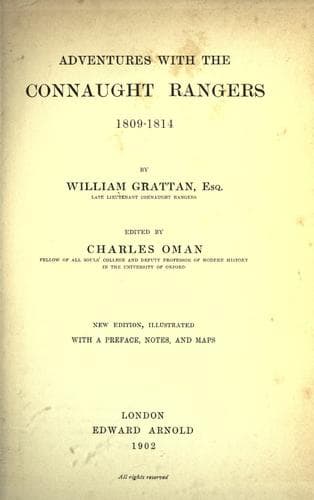
Adventures with the Connaught Rangers, 1809-1814 — John Shaqi
Adventures with the Connaught Rangers, 1809-1814Grattan, William
History
Adventures with the Connaught Rangers, 1809-1814
Grattan, William
Great Britain. Army. Regiment of Foot, 88th (Connaught Rangers); Peninsular War, 1807-1814 -- Personal narratives
Grattan’s other weakness was a tendency to fly off at a tangent in the
middle of a piece of interesting narrative, in order to controvert the
statements of writers with whom he disagreed. He had one special
foe—Robinson, the biographer of Sir Thomas Picton, on whom he wasted
many an objurgatory paragraph. These small controversial points, on
which he turns aside, break the thread of his discourse in the most
hopeless fashion, and are now of little interest. I have often, though
not always, thought it well to leave out such divagations. At the end of
the work, in a similar fashion, a long criticism on a certain speech of
the Duke of Wellington in the House of Lords has been omitted. It deals
with the story of the long-delayed issue of the war-medal for the
Peninsula. The whole point of Grattan’s remarks (caustic but well
justified in most respects) was removed when the medal was at last
actually distributed, a few months after he had made his complaint.
The present volume stops short at the end of the Peninsular war.
Grattan’s pen travelled farther. Encouraged by the success of his first
book, he issued two supplementary volumes: these are of very inferior
interest, being mainly concerned with the doings of the 88th in their
early campaigns, before the author had joined them. There is much about
Buenos Ayres, the Low Countries, and Talavera. The rest is composed of
amusing but very rambling reminiscences of garrison life in Canada in
1814, and in France in 1815–1816, and of character sketches of some of
Grattan’s contemporaries, such as the unfortunate Simon Fairfield,
concerning whom the reader will find certain information on pages 130–1
and 324 of this reprint. The whole of these two volumes consists of mere
_disjecta membra_, much inferior in interest to the first two which the
author had produced.
Public-domain text, read in full here on John Shaqi.
Reviews
Reviews
No reviews yet
Be the first to share your thoughts on this work.
Join the Discussion
Join the discussion
Sign in to leave a comment or review.
Sign InorCreate an account