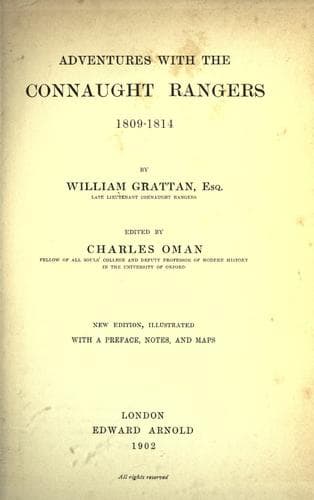
Adventures with the Connaught Rangers, 1809-1814Grattan, William
History
Adventures with the Connaught Rangers, 1809-1814
Grattan, William
Great Britain. Army. Regiment of Foot, 88th (Connaught Rangers); Peninsular War, 1807-1814 -- Personal narratives
On the 15th we surprised their covering division while in the act of
cooking near the village of Foz d'Aronce. They retreated in the greatest
hurry, leaving several camp kettles full of meat behind them. As we
approached the town, the road leading to it was covered with a number of
horses, mules, and asses, all maimed; but the most disgusting sight was
about fifty of the asses floundering in the mud, some with their throats
half cut, while others were barbarously houghed or otherwise injured.
What the object of this proceeding meant I never could guess; the poor
brutes could have been of no use to us, or indeed any one else, as I
believe they were unable to have travelled another league. The meagre
appearance of these creatures, with their backbones and hips protruding
through their hides, and their mangled and bleeding throats, produced a
general feeling of disgust and commiseration.
The village of Foz d'Aronce was warmly contested, and more than once
taken and retaken. Night put a stop to this affair, in which we
sustained a loss of about four hundred men. The enemy lost nearly a
thousand _hors de combat_;[10] and, as usual, taking advantage of the
night, got off, and continued their retreat upon Guarda, having
destroyed the bridge on the river Ceira as they retired.
-----
Footnote 10:
These figures are very wild. The English lost 4 officers and 60 men,
the French 456 killed and wounded only, according to the official
accounts.
-----
The army did not lose any officer of rank in the affair of Foz d'Aronce,
but the service sustained a loss in Lieutenant Heppenstal—a young man
who, had he lived, would have been an ornament to a profession for which
Nature seemed to have destined him. He was known to be one of the
bravest men in the army, but on this occasion his usual spirits deserted
him. He moved along silent, inattentive, and abstracted—a brisk firing
in our front soon roused all his wonted energy, and he advanced with his
men apparently cheerful as ever; turning to a brother officer he said,
“You will laugh at what I am going to say; you know I am not afraid to
die, but I have a certain feeling that my race is nearly run.”—“You
jest,” said his friend. “No, I don’t,” was his reply; they shook hands,
the light troops advanced, and in a few minutes the brave Heppenstal was
a corpse. His presentiment was too just, and though I had heard of
instances of the kind before, this was the first that came under my
immediate observation. I ran up to the spot where he lay; he was
bleeding profusely; his breast was penetrated by two bullets, and a
third passed through his forehead. His death was singular, and it
appeared as if he was resolved to fulfil the destiny that he had marked
out for himself. Our light troops were gradually retreating on their
reinforcements, and were within a few paces of the columns of infantry;
his men repeatedly called out to him to retire with the rest, but he,
Public-domain text, read in full here on John Shaqi.
Reviews
Reviews
No reviews yet
Be the first to share your thoughts on this work.
Join the Discussion
Join the discussion
Sign in to leave a comment or review.
Sign InorCreate an account