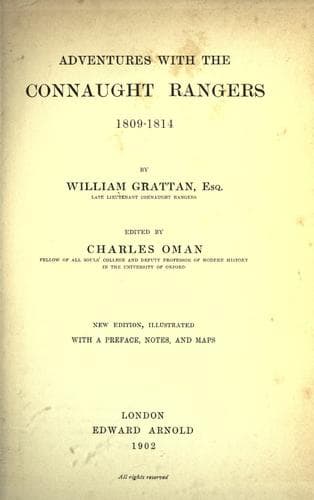
Adventures with the Connaught Rangers, 1809-1814 — John Shaqi
Adventures with the Connaught Rangers, 1809-1814Grattan, William
History
Adventures with the Connaught Rangers, 1809-1814
Grattan, William
Great Britain. Army. Regiment of Foot, 88th (Connaught Rangers); Peninsular War, 1807-1814 -- Personal narratives
either not hearing, or not attending to what they said, remained, with
his back against a pine-tree, dealing out death at every shot. Pressed
as we were for time, we dug him a deep grave at the foot of the tree
where he so gallantly lost his life, and we laid him in it without form
or ceremony.
Nothing particular occurred after the action of Foz d'Aronce until our
arrival at Guarda. As usual, we met with groups of murdered peasantry
and of French soldiers. At the entrance of a cave, amidst these rocky
mountains, lay an old man, a woman, and two young men, all dead. This
cave, no doubt, had served them as an asylum the preceding winter, and
appearances warranted the supposition that these poor creatures, in a
vain effort to save their little store of provisions, fell victims to
the ferocity of their murderers. The clothes of the two young peasants
were torn to atoms, and bore ample testimony that they did not lose
their lives without a struggle to preserve them; the hands of one were
dreadfully mangled, as if in a last effort to save his life he had
grasped the sword which ultimately despatched him. Beside him lay his
companion, his brother perhaps, covered with wounds; and a little to the
right was the old man. He lay on his back with his breast bare; two
large gashes were over his heart, and the back part of his head was
beaten to pieces. Near him lay an old rusty bayonet fixed on a pole,
which formerly served as a goad for oxen, and one of his hands grasped a
bunch of hair, torn, no doubt, from the head of the assassin; the old
woman was in all probability strangled, as no wound appeared on her
body.
At some distance from this spot were two French soldiers belonging to
the 4th Léger; their appearance was frightful. They had been wounded by
our advance, and their companions either being too much occupied in
providing for their own safety to think of them, or their situation
being too hopeless to entertain an idea of their surviving, they were
abandoned to the fury of the peasants, who invariably dodged on the
flanks or in the rear of our troops. These poor wretches were surrounded
by half a dozen Portuguese, who, after having plundered them, were
taking that horrible vengeance too common during this contest. On the
approach of our men they dispersed, but, as we passed on, we could
perceive them returning like vultures that have been scared away from
their prey for the moment, but who return to it again with redoubled
voraciousness. Both the Frenchmen were alive, and entreated us to put an
end to their sufferings. I thought it would have been humane to do so,
but Napoleon and Jaffa flashed across me, and I turned away from the
spot.[11]
-----
Footnote 11:
The reference is to the discredited story that Napoleon poisoned all
his non-transportable wounded at Jaffa, during his retreat to Egypt,
in order to prevent them from being massacred by the Turks.
-----
Public-domain text, read in full here on John Shaqi.
Reviews
Reviews
No reviews yet
Be the first to share your thoughts on this work.
Join the Discussion
Join the discussion
Sign in to leave a comment or review.
Sign InorCreate an account