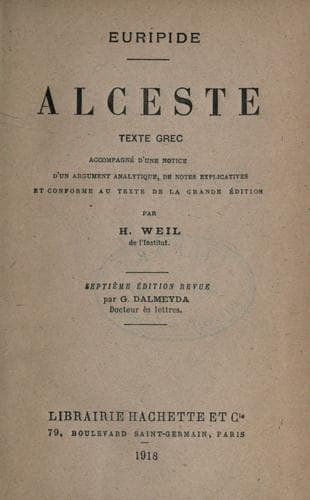
Alcestis, Queen, consort of Admetus, King of Pherae -- Drama
P. 9, l. 112, To wander o'er leagues of land.]--You could sometimes save a
sick person by appealing to an oracle, such as that of Apollo in Lycia or
of Zeus Ammon in the Libyan desert; but now no sacrifice will help. Only
Asclepios, were he still on earth, might have helped us. (See on the
Prologue.)
P. 12, l. 150, 'Fore God she dies high-hearted.]--What impresses the Elder
is the calm and deliberate way in which Alcestis faces these preparations.
P. 12, l. 162, Before the Hearth-Fire.]--Hestia, the hearth-fire, was a
goddess, the Latin Vesta, and is addressed as "Mother." It is
characteristic in Alcestis to think chiefly about happy marriages for the
children.
P. 12, l. 182, Happier perhaps, more true she cannot be.]--A famous line
and open to parody. Cf. Aristophanes, _Knights_, 1251 ("Another wear
this crown instead of me, Happier perhaps; worse thief he cannot be"). And
see on l. 367 below.
P. 15, l. 228, Hearts have bled.]--People have committed suicide for less
than this.
P. 16, l. 244, O Sun.]--Alcestis has come out to see the Sun and Sky for
the last time and say good-bye to them. It is a rite or practice often
mentioned in Greek poetry. Her beautiful wandering lines about Charon and
his boat are the more natural because she is not dying from any disease
but is being mysteriously drawn away by the Powers of Death.
P. 16, l. 252, A boat, two-oared.]--She sees Charon, the boatman who
ferried the souls of the dead across the river Styx.
P. 17, l. 259, Drawing, drawing.]--The creature whom she sees drawing her
to "the palaces of the dead" is certainly not Charon, who had no wings,
but was like an old boatman in a peasant's cap and sleeveless tunic; nor
can he be Hades, the throned King to whose presence she must eventually
go. Apparently, therefore, he must be Thanatos, whom we have just seen on
the stage. He was evidently supposed to be invisible to ordinary human
eyes.
P. 18, l. 280, Alcestis's speech.]--Great simplicity and sincerity are the
keynotes of this fine speech. Alcestis does not make light of her
sacrifice: she enjoyed her life and values it; she wishes one of the old
people had died instead; she is very earnest that Admetus shall not marry
again, chiefly for the children's sake, but possibly also from some little
shadow of jealousy. A modern dramatist would express all this, if at all,
by a scene or a series of scenes of conversation; Euripides always uses
the long self-revealing speech. Observe how little romantic love there is
in Alcestis, though Admetus is full of it. See Preface, pp. xiii, xiv.
Public-domain text, read in full here on John Shaqi.
Reviews
Reviews
No reviews yet
Be the first to share your thoughts on this work.
Join the Discussion
Join the discussion
Sign in to leave a comment or review.
Sign InorCreate an account