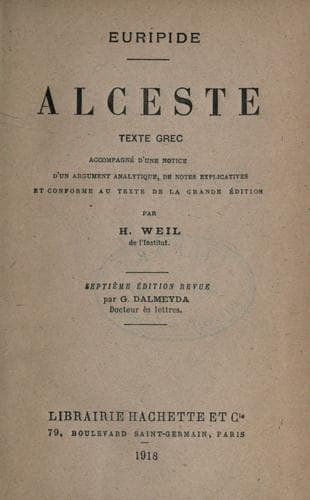
Alcestis, Queen, consort of Admetus, King of Pherae -- Drama
Pp. 19, 20, l. 328 ff., Admetus's speech.]--If the last speech made us
know Alcestis, this makes us know Admetus fully as well. At one time the
beauty and passion of it almost make us forget its ultimate hollowness; at
another this hollowness almost makes us lose patience with its beautiful
language. In this state of balance the touch of satire in l. 338 f. ("My
mother I will know no more," etc.), and the fact that he speaks
immediately after the complete sincerity of Alcestis, conspire to weigh
down the scale against Admetus. There can be no doubt that he means, and
means passionately, all that he says. Only he could not quite manage to
die when it was not strictly necessary.
P. 20, l. 355, If Orpheus' voice were mine.]--The bard and prophet,
Orpheus, went down to the dead to win back his wife, Eurydice. Hades and
Persephonê, spell-bound by his music, granted his prayer that Eurydicê
should return to the light, on condition that he should go before her,
harping, and should never look back to see if she was following. Just at
the end of the journey he looked back, and she vanished. The story is told
with overpowering beauty in Vergil's fourth Georgic.
P. 21, l. 367, Oh, not in death from thee Divided.]--Parodied in
Aristophanes' _Archarnians_ 894, where it is addressed to an eel, and
the second line ends "in a beet-root fricassee." See on l. 182.
P. 23, l. 393 ff., The Little Boy's speech.]--Classical Greek sculpture
and vase-painting tended to represent children not like children but like
diminutive men; and something of the sort is true of Greek tragedy.
The stately tragic convention has in the main to be maintained; the child
must speak a language suited for heroes, or at least for high poetry.
The quality of childishness has to be indicated by a word or so of
child-language delicately admitted amid the stateliness. Here we have
[Greek: maia], something like "mummy," at the beginning, and [Greek:
neossos], "chicken" or "little bird," at the end. Otherwise most of the
language is in the regular tragic diction, and some of it doubtless seems
to us unsuitable for a child. If Milton had had to make a child speak in
_Paradise Lost_, what sort of diction would he have given it?
Public-domain text, read in full here on John Shaqi.
Reviews
Reviews
No reviews yet
Be the first to share your thoughts on this work.
Join the Discussion
Join the discussion
Sign in to leave a comment or review.
Sign InorCreate an account