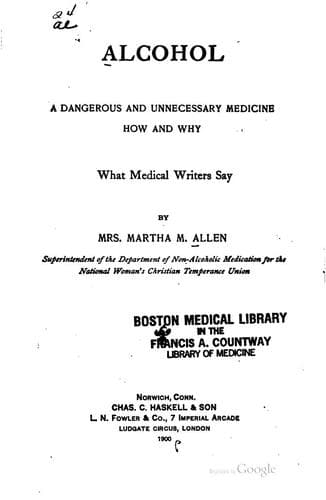
Alcohol: A Dangerous and Unnecessary Medicine, How and Why: What Medical Writers SayAllen, Martha Meir
Science
Alcohol: A Dangerous and Unnecessary Medicine, How and Why: What Medical Writers Say
Allen, Martha Meir
Alcohol -- Physiological effect; Temperance
"In view of these facts, is it not a pertinent question to ask
how alcohol can be of service in the treatment of such disorders
as pneumonia, typhoid fever, cholera, erysipelas and other
infections, since it acts in such a decided and powerful manner
in diminishing urinary toxicity--in other words, in lessening
the ability of the kidney to eliminate toxic substances? In
infectious diseases of every sort, the body is struggling under
the influence of toxic agents, the result of the action of
microbes. Alcohol is another toxic agent of precisely the same
origin. Like other toxins resulting from like processes of
bacterial growth, its influence upon the human organism is
unfriendly; it disturbs the vital processes; it disturbs every
vital function, and, as we have shown, in a most marked degree
diminishes the efficiency of the kidneys in the removal of the
toxins which constitute the most active factor in the diseases
named, and in others of analogous character. If a patient is
struggling under the influence of the pneumococcus, Eberth's
bacillus, Koch's cholera microbe or the pus-producing germs
which give rise to erysipelatous inflammation, his kidneys
laboring to undo, so far as possible, the mischief done by the
invading parasites, by eliminating the poisons formed by them,
what good could possibly be accomplished by the administration
of a drug, one of the characteristic effects of which is to
diminish renal activity, thereby diminishing also the quantity
of poisons eliminated through this channel? Is not such a course
in the highest degree calculated to add fuel to the flame? Is it
not placing obstacles in the way of the vital forces which are
already hampered in their work by the powerfully toxic agents to
the influence of which they are subjected?
"In his address before the American Medical Association at
Milwaukee, Dr. Ernest Hart, editor of the _British Medical
Journal_, very aptly suggested in relation to the treatment of
cholera, the inutility of alcohol, basing his suggestion upon
the fact that in a case of cholera, the system of the patient is
combating the specific poison which is the product of the
microbe of this disease, and hence is not likely to be aided by
the introduction of a poison produced by another microbe;
namely, alcohol. This logic seems very sound, and the facts in
relation to the influence of alcohol upon urinary toxicity or
renal activity, which are elucidated by our experiment, fully
sustain this observation of Mr. Hart.
Public-domain text, read in full here on John Shaqi.
Reviews
Reviews
No reviews yet
Be the first to share your thoughts on this work.
Elsewhere in the archive
Join the Discussion
Join the discussion
Sign in to leave a comment or review.
Sign InorCreate an account