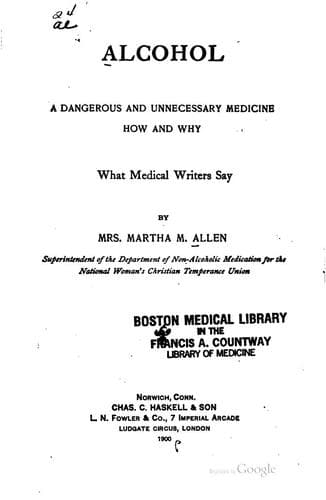
Alcohol: A Dangerous and Unnecessary Medicine, How and Why: What Medical Writers SayAllen, Martha Meir
Science
Alcohol: A Dangerous and Unnecessary Medicine, How and Why: What Medical Writers Say
Allen, Martha Meir
Alcohol -- Physiological effect; Temperance
"We have already mentioned that Massart and Bordet some years
ago pointed out that alcohol, even in very dilute solutions,
exerts a very active negative chemiotaxis, i. e., it appears to
have properties by which leucocytes are repelled or driven away
from its neighborhood and actions. Alcohol thus prevents the
cells from attacking invading bodies or of reacting in the
presence of the toxins which also, as is well known, exert a
more or less marked negative chemiotaxis, i.e., the cells appear
to be paralyzed. In all diseases, then, in which the leucocytes
help to remove an invading organism or in which they have the
power of reacting or of carrying on their functions in the
presence of a toxin, we should expect that alcohol would to a
certain extent deprive them of this power or interfere with
their capacity for acquiring a greater resisting power or of
reinforcing the powers of resistance. It appears indeed to
reinforce the poison formed by pathogenic organisms. Dr.
Delearde maintains moreover that chronic alcoholism increases
enormously the difficulty of rendering an animal immune to
anthrax, whilst as those who have had any experience of cases of
anthrax know full well alcoholics, whether acute or chronic,
manifest a remarkable susceptibility both as regards attacks of
anthrax and the fatality of the disease when once contracted.
Further as clinical proof of the correctness of another of these
sets of experiments, Dr. Delearde instances two cases of rabies
which have come under observation in the Institut Pasteur--one,
a man of 30 years of age, of intemperate habits who after a
complete treatment of 18 days after a bite in the hand died of
hydrophobia; the other, a child of 13 years who was bitten on
the face by the same dog that had attacked the other patient,
and on the same day--who underwent the same treatment remained
perfectly well. In this case the more severe bite (the face
being the most serious position in which a person can be bitten)
was received by the child; indeed the intemperate habits of the
man, who even took alcohol during treatment, appear to have been
the only more serious factor in his case as compared with that
of the child.
Public-domain text, read in full here on John Shaqi.
Reviews
Reviews
No reviews yet
Be the first to share your thoughts on this work.
Elsewhere in the archive
Join the Discussion
Join the discussion
Sign in to leave a comment or review.
Sign InorCreate an account