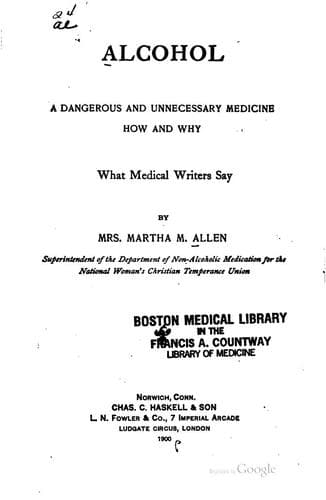
Alcohol: A Dangerous and Unnecessary Medicine, How and Why: What Medical Writers SayAllen, Martha Meir
Science
Alcohol: A Dangerous and Unnecessary Medicine, How and Why: What Medical Writers Say
Allen, Martha Meir
Alcohol -- Physiological effect; Temperance
The ability to add figures was tested, and this decreased very rapidly
under minute doses of alcohol. Memory tests showed that only 60 figures
could be remembered from numbers written in columns after alcohol had
been taken, while 100 figures could be remembered correctly when the
mind was free from the alcoholic influence. Type-setters were tested,
and the average number of errors they made and the amount of work they
did in a given time was carefully recorded. After a small dose of
alcohol none of the men could in the same time do as much work, or as
accurate work. Yet every one of the men experimented upon thought he was
doing better work after his drink. This proves the narcotic effect of
alcohol.
The economic loss to a people from beer and wine drinking is worthy of
serious consideration since a bottle of wine or its equivalent in beer
could diminish by ten to fifteen per cent. the amount of work done by
these type-setters experimented upon by Professor Aschaffenberg.
Professor Kraepelin says:--
"I must admit that my experiments, extending over more than ten
years, have made me an opponent of alcohol."
He says again:--
"The laborer who wins his livelihood by the working power of his
arm strikes at the very foundation of his power by the use of
alcohol."
Professor Aschaffenberg says of moderate doses:--
"Any quantity of alcohol must be regarded as considerable which
causes a disturbance, even if only transitory, of bodily and
mental efficiency."
Public-domain text, read in full here on John Shaqi.
Reviews
Reviews
No reviews yet
Be the first to share your thoughts on this work.
Elsewhere in the archive
Join the Discussion
Join the discussion
Sign in to leave a comment or review.
Sign InorCreate an account