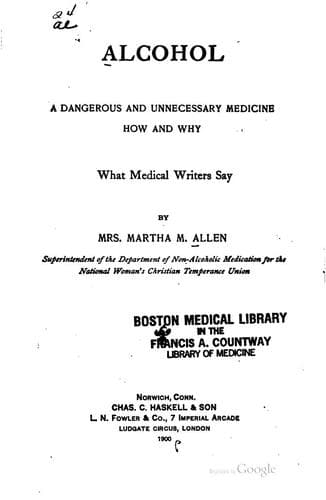
Alcohol: A Dangerous and Unnecessary Medicine, How and Why: What Medical Writers SayAllen, Martha Meir
Science
Alcohol: A Dangerous and Unnecessary Medicine, How and Why: What Medical Writers Say
Allen, Martha Meir
Alcohol -- Physiological effect; Temperance
Dr. Reid Hunt, chief of the Division of Pharmacology, Hygienic
Laboratory, United States Public Health and Marine Hospital Service,
made some very interesting experiments to determine the physiological
changes upon animals which would result from the strictly moderate use
of alcohol. These are described in Bulletin No. 33 of the Hygienic
Laboratory, published in 1907. Mice and guinea-pigs were used. The food,
usually oats, was soaked in diluted alcohol, at first of five per cent.
strength, then gradually increased to forty or fifty per cent. By
carefully observing the weight of the mice, and not increasing the
strength of the alcohol too rapidly, it was possible to keep the animals
for months on this diet without any material loss of weight. After the
lapse of weeks, in some cases, and months in other cases, these alcohol
fed animals were given small doses of a poison known as acetonitrile.
Other mice to whom no alcohol was fed were given similar doses of this
poison. In the first series the mice which had received alcohol died
from about one-half the quantity of acetonitrile required to kill those
which had not received alcohol. In the second series with a somewhat
stronger dilution the alcohol mice succumbed to one-half to one-third
the dose necessary to kill the non-alcoholized animals. In no case was
enough alcohol given for any symptoms of intoxication to appear, nor was
there any outward indication of any injury being done by the alcohol. In
another experiment a mouse was kept for four months on a diet of oats
soaked in water, then 0.5 milligram of acetonitrile per gram body weight
was injected. The mouse recovered. It was then fed on oats soaked in an
alcoholic solution which was gradually increased to 45 per cent. After a
little more than a month of this diet 0.2 milligram acetonitrile per
gram body weight proved fatal. The weight of the mouse had remained
about the same throughout.
Alcohol increased the susceptibility of the guinea pigs also.
Dr. Hunt says on page 33 of the bulletin:--
Public-domain text, read in full here on John Shaqi.
Reviews
Reviews
No reviews yet
Be the first to share your thoughts on this work.
Elsewhere in the archive
Join the Discussion
Join the discussion
Sign in to leave a comment or review.
Sign InorCreate an account