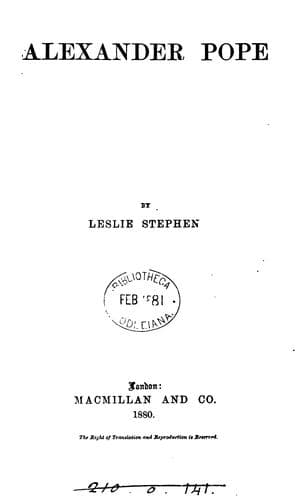
Poets, English -- 18th century -- Biography; Pope, Alexander, 1688-1744
The dominant figure in Pope's day was the Wit. The wit--taken
personally--was the man who represented what we now describe by culture
or the spirit of the age. Bright clear common sense was for once having
its own way, and tyrannizing over the faculties from which it too often
suffers violence. The favoured faculty never doubted its own
qualification for supremacy in every department. In metaphysics it was
triumphing with Hobbes and Locke over the remnants of scholasticism;
under Tillotson, it was expelling mystery from religion; and in art it
was declaring war against the extravagant, the romantic, the mystic, and
the Gothic,--a word then used as a simple term of abuse. Wit and sense
are but different avatars of the same spirit; wit was the form in which
it showed itself in coffee-houses, and sense that in which it appeared
in the pulpit or parliament. When Walsh told Pope to be correct, he was
virtually advising him to carry the same spirit into poetry. The
classicism of the time was the natural corollary; for the classical
models were the historical symbols of the movement which Pope
represented. He states his view very tersely in the essay. Classical
culture had been overwhelmed by the barbarians, and the monks "finished
what the Goths began." Letters revived when the study of classical
models again gave an impulse and supplied a guidance.
At length Erasmus, that great injured name,
The glory of the priesthood and their shame,
Stemm'd the wild torrent of a barbarous age,
And drove these holy Vandals off the stage.
The classicalism of Pope's time was no doubt very different from that of
the period of Erasmus; but in his view it differed only because the
contemporaries of Dryden had more thoroughly dispersed the mists of the
barbarism which still obscured the Shakspearean age, and from which even
Milton or Cowley had not completely escaped. Dryden and Boileau and the
French critics, with their interpreters Roscommon, Sheffield, and Walsh,
who found rules in Aristotle, and drew their precedents from Homer,
were at last stating the pure canons of unadulterated sense. To this
school, wit and sense, and nature, and the classics, all meant pretty
much the same. That was pronounced to be unnatural which was too silly,
or too far-fetched, or too exalted, to approve itself to the good sense
of a wit; and the very incarnation and eternal type of good sense and
nature was to be found in the classics. The test of thorough polish and
refinement was the power of ornamenting a speech with an appropriate
phrase from Horace or Virgil, or prefixing a Greek motto to an essay in
the _Spectator_. If it was necessary to give to any utterance an air of
philosophical authority, a reference to Longinus or Aristotle was the
natural device. Perhaps the acquaintance with classics might not be very
profound; but the classics supplied at least a convenient symbol for the
spirit which had triumphed against Gothic barbarism and scholastic
pedantry.
Public-domain text, read in full here on John Shaqi.
Reviews
Reviews
No reviews yet
Be the first to share your thoughts on this work.
Join the Discussion
Join the discussion
Sign in to leave a comment or review.
Sign InorCreate an account