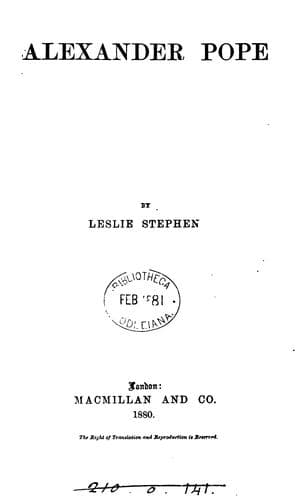
Poets, English -- 18th century -- Biography; Pope, Alexander, 1688-1744
Even the priggish wits of that day were capable of being bored by
didactic poetry, and especially by such didactic poetry as resolved
itself too easily into a string of maxims, not more poetical in
substance than the immortal "'Tis a sin to steal a pin." The
essay--published anonymously--did not make any rapid success till Pope
sent round copies to well-known critics. Addison's praise and Dennis's
abuse helped, as we shall presently see, to give it notoriety. Pope,
however, returned from criticism to poetry, and his next performance was
in some degree a fresh, but far less puerile, performance upon the
pastoral pipe.[4] Nothing could be more natural than for the young poet
to take for a text the forest in which he lived. Dull as the natives
might be, their dwelling-place was historical, and there was an
excellent precedent for such a performance. Pope, as we have seen, was
familiar with Milton's juvenile poems; but such works as the Allegro and
Penseroso were too full of the genuine country spirit to suit his
probable audience. Wycherley, whom he frequently invited to come to
Binfield, would undoubtedly have found Milton a bore. But Sir John
Denham, a thoroughly masculine, if not, as Pope calls him, a majestic
poet, was a guide whom the Wycherleys would respect. His _Cooper's Hill_
(in 1642) was the first example of what Johnson calls local
poetry--poetry, that is, devoted to the celebration of a particular
place; and, moreover, it was one of the early models of the rhythm which
became triumphant in the hands of Dryden. One couplet is still
familiar:--
Though deep, yet clear; though gentle, yet not dull;
Strong without rage; without o'erflowing, full.
The poem has some vigorous descriptive touches, but is in the main a
forcible expression of the moral and political reflections which would
be approved by the admirers of good sense in poetry.
Pope's _Windsor Forest_, which appeared in the beginning of 1713, is
closely and avowedly modelled upon this original. There is still a
considerable infusion of the puerile classicism of the Pastorals, which
contrasts awkwardly with Denham's strength, and a silly episode about
the nymph Lodona changed into the river Loddon by Diana, to save her
from the pursuit of Pan. But the style is animated, and the
descriptions, though seldom original, show Pope's frequent felicity of
language. Wordsworth, indeed, was pleased to say that Pope had here
introduced almost the only "new images of internal nature" to be found
between Milton and Thomson. Probably the good Wordsworth was wishing to
do a little bit of excessive candour. Pope will not introduce his
scenery without a turn suited to the taste of the town:--
Here waving groves a chequer'd scene display,
And part admit and part exclude the day;
As some coy nymph her lover's fond address,
Nor quite indulges nor can quite repress.
Public-domain text, read in full here on John Shaqi.
Reviews
Reviews
No reviews yet
Be the first to share your thoughts on this work.
Join the Discussion
Join the discussion
Sign in to leave a comment or review.
Sign InorCreate an account