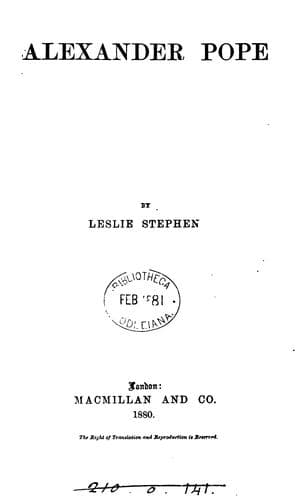
Poets, English -- 18th century -- Biography; Pope, Alexander, 1688-1744
It is probable that no first performance of a play upon the English
stage ever excited so much interest as that of Addison's _Cato_. It was
not only the work of the first man of letters of the day, but it had, or
was taken to have, a certain political significance. "The time was
come," says Johnson, "when those who affected to think liberty in danger
affected likewise to think that a stage-play might preserve it."
Addison, after exhibiting more than the usual display of reluctance,
prepared his play for representation, and it was undoubtedly taken to be
in some sense a Whig manifesto. It was therefore remarkable that he
should have applied to Pope for a prologue, though Pope's connexions
were entirely of the anti-Whiggish kind, and a passage in _Windsor
Forest_, his last new poem (it appeared in March 1713), indicated pretty
plainly a refusal to accept the Whig shibboleths. In the _Forest_ he was
enthusiastic for the peace, and sneered at the Revolution. Pope
afterwards declared that Addison had disavowed all party intentions at
the time, and he accused him of insincerity for afterwards taking credit
(in a poetical dedication of _Cato_) for the services rendered by his
play to the cause of liberty. Pope's assertion is worthless in any case
where he could exalt his own character for consistency at another man's
expense, but it is true that both parties were inclined to equivocate.
It is, indeed, difficult to understand how, if any "stage-play could
preserve liberty," such a play as _Cato_ should do the work. The
polished declamation is made up of the platitudes common to Whigs and
Tories; and Bolingbroke gave the one to his own party when he presented
fifty guineas to _Cato_'s representative for defending the cause of
liberty so well against a perpetual dictator. The Whigs, said Pope,
design a second present when they can contrive as good a saying.
Bolingbroke was, of course, aiming at Marlborough, and his
interpretation was intrinsically as plausible as any that could have
been devised by his antagonists. Each side could adopt _Cato_ as easily
as rival sects can quote the Bible; and it seems possible that Addison
may have suggested to Pope that nothing in _Cato_ could really offend
his principles. Addison, as Pope also tells us, thought the prologue
ambiguous, and altered "Britons, _arise_!" to "Britons, _attend_!" lest
the phrase should be thought to hint at a new revolution. Addison
advised Pope about this time not to be content with the applause of
"half the nation," and perhaps regarded him as one who, by the fact of
his external position with regard to parties, would be a more
appropriate sponsor for the play.
Public-domain text, read in full here on John Shaqi.
Reviews
Reviews
No reviews yet
Be the first to share your thoughts on this work.
Join the Discussion
Join the discussion
Sign in to leave a comment or review.
Sign InorCreate an account