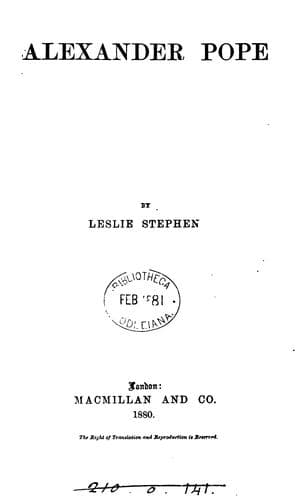
Poets, English -- 18th century -- Biography; Pope, Alexander, 1688-1744
Whatever the intrinsic significance of _Cato_, circumstances gave it a
political colour; and Pope, in a lively description of the first
triumphant night to his friend Caryll, says, that as author of the
successful and very spirited prologue, he was clapped into a Whig,
sorely against his will, at every two lines. Shortly before he had
spoken in the warmest terms to the same correspondent of the admirable
moral tendency of the work; and perhaps he had not realized the full
party significance till he became conscious of the impression produced
upon the audience. Not long afterwards (letter of June 12, 1713), we
find him complaining that his connexion with Steele and the _Guardian_
was giving offence to some honest Jacobites. Had they known the nature
of the connexion, they need hardly have grudged Steele his contributor.
His next proceedings possibly suggested the piece of advice which
Addison gave to Lady M. W. Montagu: "Leave Pope as soon as you can; he
will certainly play you some devilish trick else."
His first trick was calculated to vex an editor's soul. Ambrose Philips,
as I have said, had published certain pastorals in the same volume with
Pope's. Philips, though he seems to have been less rewarded than most of
his companions, was certainly accepted as an attached member of
Addison's "little senate;" and that body was not more free than other
mutual admiration societies from the desire to impose its own prejudices
upon the public. When Philips's _Distressed Mother_, a close imitation
of Racine's _Andromaque_, was preparing for the stage, the Spectator was
taken by Will Honeycomb to a rehearsal (_Spectator_, January 31, 1712),
and Sir Roger de Coverley himself attended one of the performances
(_Ib._, March 25) and was profoundly affected by its pathos. The last
paper was of course by Addison, and is a real triumph of art as a most
delicate application of humour to the slightly unworthy purpose of
puffing a friend and disciple. Addison had again praised Philips's
Pastorals in the _Spectator_ (October 30, 1712), and amongst the early
numbers of the _Guardian_ were a short series of papers upon pastoral
poetry, in which the fortunate Ambrose was again held up as a model,
whilst no notice was taken of Pope's rival performance. Pope, one may
believe, had a contempt for Philips, whose pastoral inanities, whether
better or worse than his own, had not the excuse of being youthful
productions. Philips has bequeathed to our language the phrase
"Namby-pamby," imposed upon him by Henry Carey (author of _Sally in our
Alley_, and the clever farce _Chrononhotonthologos_), and years after
this he wrote a poem to Miss Pulteney in the nursery, beginning,--
"Dimply damsel, sweetly smiling,"
Public-domain text, read in full here on John Shaqi.
Reviews
Reviews
No reviews yet
Be the first to share your thoughts on this work.
Join the Discussion
Join the discussion
Sign in to leave a comment or review.
Sign InorCreate an account