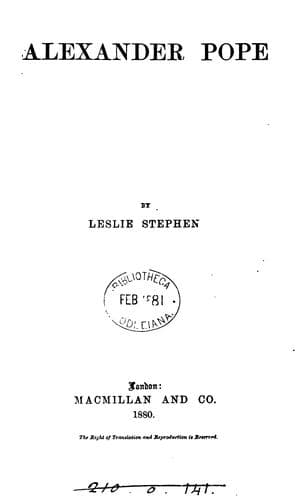
Poets, English -- 18th century -- Biography; Pope, Alexander, 1688-1744
which may sufficiently interpret the meaning of his nickname. Pope's
irritable vanity was vexed at the liberal praises bestowed on such a
rival, and he revenged himself by an artifice more ingenious than
scrupulous. He sent an anonymous article to Steele for the _Guardian_.
It is a professed continuation of the previous papers on pastorals, and
is ostensibly intended to remove the appearance of partiality arising
from the omission of Pope's name. In the first paragraphs the design is
sufficiently concealed to mislead an unwary reader into the belief that
Philips is preferred to Pope; but the irony soon becomes transparent,
and Philips's antiquated affectation is contrasted with the polish of
Pope, who is said even to "deviate into downright poetry." Steele, it is
said, was so far mystified as to ask Pope's permission to publish the
criticism. Pope generously permitted, and accordingly Steele printed
what he must soon have discovered to be a shrewd attack upon his old
friend and ally. Some writers have found a difficulty in understanding
how Steele could have so blundered. One might, perhaps, whisper in
confidence to the discreet, that even editors are mortal, and that
Steele was conceivably capable of the enormity of reading papers
carelessly. Philips was furious, and hung up a birch in Button's
Coffee-house, declaring that he would apply it to his tormentor should
he ever show his nose in the room. As Philips was celebrated for skill
with the sword, the mode of vengeance was certainly unmanly, and stung
the soul of his adversary, always morbidly sensitive to all attacks, and
especially to attacks upon his person. The hatred thus kindled was never
quenched, and breathes in some of Pope's bitterest lines.
Public-domain text, read in full here on John Shaqi.
Reviews
Reviews
No reviews yet
Be the first to share your thoughts on this work.
Join the Discussion
Join the discussion
Sign in to leave a comment or review.
Sign InorCreate an account