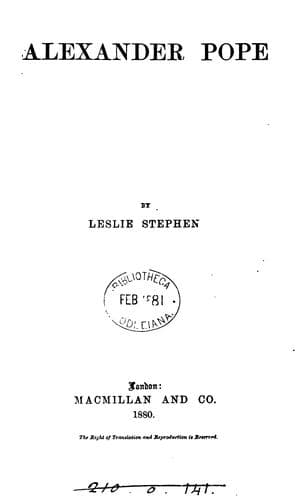
Poets, English -- 18th century -- Biography; Pope, Alexander, 1688-1744
A translation of the first Iliad by Tickell appeared (in June, 1715)
simultaneously with Pope's first volume. Pope had no right to complain.
No man could be supposed to have a monopoly in the translation of Homer.
Tickell had the same right to try his hand as Pope; and Pope fully
understood this himself. He described to Spence a conversation in which
Addison told him of Tickell's intended work. Pope replied that Tickell
was perfectly justified. Addison having looked over Tickell's
translation of the first book, said that he would prefer not to see
Pope's, as it might suggest double dealing; but consented to read Pope's
second book, and praised it warmly. In all this, by Pope's own showing,
Addison seems to have been scrupulously fair; and if he and the little
senate preferred Tickell's work on its first appearance, they had a full
right to their opinion, and Pope triumphed easily enough to pardon them.
"He was meditating a criticism upon Tickell," says Johnson, "when his
adversary sank before him without a blow." Pope's performance was
universally preferred, and even Tickell himself yielded by anticipation.
He said, in a short preface, that he had abandoned a plan of translating
the whole Iliad on finding that a much abler hand had undertaken the
work, and that he only published this specimen to bespeak favour for a
translation of the Odyssey. It was, say Pope's apologists, an awkward
circumstance that Tickell should publish at the same time as Pope, and
that is about all that they can say. It was, we may reply in
Stephenson's phrase, very awkward--for Tickell. In all this, in fact, it
seems impossible for any reasonable man to discover anything of which
Pope had the slightest ground of complaint; but his amazingly irritable
nature was not to be calmed by reason. The bare fact that a translation
of Homer appeared contemporaneously with his own, and that it came from
one of Addison's court, made him furious. He brooded over it, suspected
some dark conspiracy against his fame, and gradually mistook his morbid
fancies for solid inference. He thought that Tickell had been put up by
Addison as his rival, and gradually worked himself into the further
belief that Addison himself had actually written the translation which
passed under Tickell's name. It does not appear, so far as I know, when
or how this suspicion became current. Some time after Addison's death,
in 1719, a quarrel took place between Tickell, his literary executor,
and Steele. Tickell seemed to insinuate that Steele had not sufficiently
acknowledged his obligations to Addison, and Steele, in an angry retort,
called Tickell the "reputed translator" of the first Iliad, and
challenged him to translate another book successfully. The innuendo
shows that Steele, who certainly had some means of knowing, was willing
to suppose that Tickell had been helped by Addison. The manuscript of
Tickell's work, which has been preserved, is said to prove this to be an
Public-domain text, read in full here on John Shaqi.
Reviews
Reviews
No reviews yet
Be the first to share your thoughts on this work.
Join the Discussion
Join the discussion
Sign in to leave a comment or review.
Sign InorCreate an account