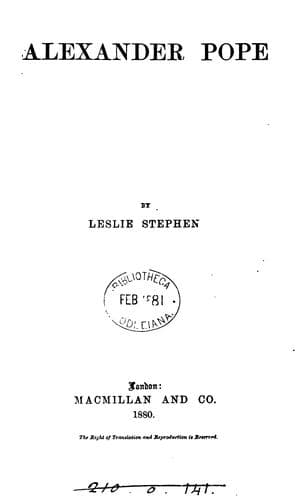
Poets, English -- 18th century -- Biography; Pope, Alexander, 1688-1744
The artificial diction about which so much has been said is the natural
vehicle of this treatment. The set of phrases and the peculiar mould
into which his sentences were cast, was already the accepted type for
poetry which aimed at dignity. He was following Dryden as his own
performance became the law for the next generation. The style in which a
woman is called a nymph--and women generally are "the fair"--in which
shepherds are conscious swains, and a poet invokes the muses and strikes
a lyre, and breathes on a reed, and a nightingale singing becomes
Philomel "pouring her throat," represents a fashion as worn out as hoops
and wigs. By the time of Wordsworth it was a mere survival--a dead form
remaining after its true function had entirely vanished. The proposal to
return to the language of common life was the natural revolt of one who
desired poetry to be above all things the genuine expression of real
emotion. Yet it is, I think, impossible to maintain that the diction of
poetry should be simply that of common life.
The true principle would rather seem to be that any style becomes bad
when it dies; when it is used merely as a tradition, and not as the best
mode of producing the desired impression; and when, therefore, it
represents a rule imposed from without, and is not an expression of the
spontaneous working of minds in which the corresponding impulse is
thoroughly incarnated. In such a case, no doubt, the diction becomes a
burden, and a man is apt to fancy himself a poet because he is the slave
of the external form instead of using it as the most familiar
instrument. By Wordsworth's time the Pope style was thus effete; what
ought to be the dress of thought had become the rigid armour into which
thought was forcibly compressed, and a revolt was inevitable. We may
agree, too, that his peculiar style was in a sense artificial, even in
the days of Pope. It had come into existence during the reign of the
Restoration wits, under the influence of foreign models, not as the
spontaneous outgrowth of a gradual development, and had therefore
something mechanical and conscious, even when it flourished most
vigorously. It came in with the periwigs, to which it is so often
compared, and, like the artificial headgear, was an attempt to give a
dignified or full-dress appearance to the average prosaic human being.
Having this innate weakness of pomposity and exaggeration, it naturally
expired, and became altogether ridiculous, with the generation to which
it belonged. As the wit or man of the world had at bottom a very
inadequate conception of epic poetry, he became inevitably strained and
contorted when he tried to give himself the airs of a poet.
Public-domain text, read in full here on John Shaqi.
Reviews
Reviews
No reviews yet
Be the first to share your thoughts on this work.
Join the Discussion
Join the discussion
Sign in to leave a comment or review.
Sign InorCreate an account